Digvijay, Gayatri, Falguni, Mahima, Tanya, Sachin, Lalit and Abhinav are lawyers who attend an interview. One interview is held on each day of the week from Monday to Saturday and two interviews are held on Sunday. The interviewer asks questions on any one of the subjects among company law, the Indian penal code, the Indian bankruptcy code, administrative law, constitutional law, jurisprudence, land laws and family law. Also, among the candidates’ two wear blazers, two wear ties, two carry files and two wear moccasins, each candidate has at least one of the above.
Additional information which has been given:
1. Digvijay who is interviewed on a Wednesday does not wear a blazer. Administrative law is asked on a Saturday.
2. The interviewer tries to schedule interviews such that the first letter of the day is the same as the candidates' initials.
3. The ones who carry files are either asked questions on land laws or on company law and are interviewed before Thursday.
4. The ones who wear blazers are interviewed on consecutive days which is not over the weekend.
5. If Mahima is asked questions on land laws then Abhinav will be asked on family law and vice-versa. There must be at least one day in between Mahima and Gayatri’s interview.
6. Gayatri does not know about the Indian bankruptcy code so she fails the interview.
7. Sachin and Abhinav wear moccasins while Lalit’s interview is the last and he is asked about Jurisprudence.
8. The one interviewed on Wednesday wears the same attire as what one of the candidates wears on Sunday.
MAH MBA CET Puzzles Questions
MAH MBA CET Puzzles Questions
Which candidate is asked about Administrative law?
From statement 1, 2, and 7 we can gather the following information:

Now, as per statement 2 Tanya will be interviewed either on Tuesday or Thursday and Sachin will be interviewed on either Saturday or Sunday.
If Tanya is interviewed on Thursday and Sachin is interviewed on Saturday then Gayatri must be interviewed on Sunday since statement 5 says at least a one day gap is required between Mahima and Gayatri's interview. So, Abhinav will have to be interviewed on Tuesday. [Case 1]
Similarly, If Tanya is interviewed on Thursday and Sachin is interviewed on Sunday then Gayatri must be interviewed on Saturday since statement 5 says at least a one day gap is required between Mahima and Gayatri's interview. However, Gayatri is asked questions on Indian Bankruptcy Code (IBC) (from statement 6) while the person interviewed on Saturday is asked admin law (statement 1) so this case is not possible.
If Tanya is interviewed on Tuesday and Sachin on Sunday then Gayatri will have to be interviewed on Thursday since she is asked about IBC and not admin law.
From statement 4 we know that the ones wearing blazers must be on consecutive days apart from the weekend. Also, Digivijay does not wear a blazer (statement 1) so the ones wearing a blazer can either be on Monday and Tuesday or Thursday and Friday. From statement 3 we know that the ones carrying files are interviewed before Thursday, so on any two of the days among Monday, Tuesday and Wednesday.
Even if one of the days is Wednesday, at least one person must carry a file on Monday and Tuesday. So, the ones wearing a blazer must be on Thursday and Friday.
In Case 1, upon placing the information we get the following:

However, as per statement 8, this is not possible. So, this case can be eliminated.
Similarly we can eliminate other cases. The only possible way, all the conditions are followed is:

So Option C is correct.
Digvijay, Gayatri, Falguni, Mahima, Tanya, Sachin, Lalit and Abhinav are lawyers who attend an interview. One interview is held on each day of the week from Monday to Saturday and two interviews are held on Sunday. The interviewer asks questions on any one of the subjects among company law, the Indian penal code, the Indian bankruptcy code, administrative law, constitutional law, jurisprudence, land laws and family law. Also, among the candidates’ two wear blazers, two wear ties, two carry files and two wear moccasins, each candidate has at least one of the above.
Additional information which has been given:
1. Digvijay who is interviewed on a Wednesday does not wear a blazer. Administrative law is asked on a Saturday.
2. The interviewer tries to schedule interviews such that the first letter of the day is the same as the candidates' initials.
3. The ones who carry files are either asked questions on land laws or on company law and are interviewed before Thursday.
4. The ones who wear blazers are interviewed on consecutive days which is not over the weekend.
5. If Mahima is asked questions on land laws then Abhinav will be asked on family law and vice-versa. There must be at least one day in between Mahima and Gayatri’s interview.
6. Gayatri does not know about the Indian bankruptcy code so she fails the interview.
7. Sachin and Abhinav wear moccasins while Lalit’s interview is the last and he is asked about Jurisprudence.
8. The one interviewed on Wednesday wears the same attire as what one of the candidates wears on Sunday.
Which candidate is interviewed on Thursday?
From statement 1, 2, and 7 we can gather the following information:
Now, as per statement 2 Tanya will be interviewed either on Tuesday or Thursday and Sachin will be interviewed on either Saturday or Sunday.
If Tanya is interviewed on Thursday and Sachin is interviewed on Saturday then Gayatri must be interviewed on Sunday since statement 5 says at least a one day gap is required between Mahima and Gayatri's interview. So, Abhinav will have to be interviewed on Tuesday. [Case 1]
Similarly, If Tanya is interviewed on Thursday and Sachin is interviewed on Sunday then Gayatri must be interviewed on Saturday since statement 5 says at least a one day gap is required between Mahima and Gayatri's interview. However, Gayatri is asked questions on Indian Bankruptcy Code (IBC) (from statement 6) while the person interviewed on Saturday is asked admin law (statement 1) so this case is not possible.
If Tanya is interviewed on Tuesday and Sachin on Sunday then Gayatri will have to be interviewed on Thursday since she is asked about IBC and not admin law.
From statement 4 we know that the ones wearing blazers must be on consecutive days apart from the weekend. Also, Digivijay does not wear a blazer (statement 1) so the ones wearing a blazer can either be on Monday and Tuesday or Thursday and Friday. From statement 3 we know that the ones carrying files are interviewed before Thursday, so on any two of the days among Monday, Tuesday and Wednesday.
Even if one of the days is Wednesday, at least one person must carry a file on Monday and Tuesday. So, the ones wearing a blazer must be on Thursday and Friday.
In Case 1, upon placing the information we get the following:
However, as per statement 8, this is not possible. So, this case can be eliminated.
Similarly we can eliminate other cases. The only possible way, all the conditions are followed is:
So Option A is correct.
Digvijay, Gayatri, Falguni, Mahima, Tanya, Sachin, Lalit and Abhinav are lawyers who attend an interview. One interview is held on each day of the week from Monday to Saturday and two interviews are held on Sunday. The interviewer asks questions on any one of the subjects among company law, the Indian penal code, the Indian bankruptcy code, administrative law, constitutional law, jurisprudence, land laws and family law. Also, among the candidates’ two wear blazers, two wear ties, two carry files and two wear moccasins, each candidate has at least one of the above.
Additional information which has been given:
1. Digvijay who is interviewed on a Wednesday does not wear a blazer. Administrative law is asked on a Saturday.
2. The interviewer tries to schedule interviews such that the first letter of the day is the same as the candidates' initials.
3. The ones who carry files are either asked questions on land laws or on company law and are interviewed before Thursday.
4. The ones who wear blazers are interviewed on consecutive days which is not over the weekend.
5. If Mahima is asked questions on land laws then Abhinav will be asked on family law and vice-versa. There must be at least one day in between Mahima and Gayatri’s interview.
6. Gayatri does not know about the Indian bankruptcy code so she fails the interview.
7. Sachin and Abhinav wear moccasins while Lalit’s interview is the last and he is asked about Jurisprudence.
8. The one interviewed on Wednesday wears the same attire as what one of the candidates wears on Sunday.
What subject is asked to Mahima?
From statement 1, 2, and 7 we can gather the following information:
Now, as per statement 2 Tanya will be interviewed either on Tuesday or Thursday and Sachin will be interviewed on either Saturday or Sunday.
If Tanya is interviewed on Thursday and Sachin is interviewed on Saturday then Gayatri must be interviewed on Sunday since statement 5 says at least a one day gap is required between Mahima and Gayatri's interview. So, Abhinav will have to be interviewed on Tuesday. [Case 1]
Similarly, If Tanya is interviewed on Thursday and Sachin is interviewed on Sunday then Gayatri must be interviewed on Saturday since statement 5 says at least a one day gap is required between Mahima and Gayatri's interview. However, Gayatri is asked questions on Indian Bankruptcy Code (IBC) (from statement 6) while the person interviewed on Saturday is asked admin law (statement 1) so this case is not possible.
If Tanya is interviewed on Tuesday and Sachin on Sunday then Gayatri will have to be interviewed on Thursday since she is asked about IBC and not admin law.
From statement 4 we know that the ones wearing blazers must be on consecutive days apart from the weekend. Also, Digivijay does not wear a blazer (statement 1) so the ones wearing a blazer can either be on Monday and Tuesday or Thursday and Friday. From statement 3 we know that the ones carrying files are interviewed before Thursday, so on any two of the days among Monday, Tuesday and Wednesday.
Even if one of the days is Wednesday, at least one person must carry a file on Monday and Tuesday. So, the ones wearing a blazer must be on Thursday and Friday.
In Case 1, upon placing the information we get the following:
However, as per statement 8, this is not possible. So, this case can be eliminated.
Similarly we can eliminate other cases. The only possible way, all the conditions are followed is:
Digvijay, Gayatri, Falguni, Mahima, Tanya, Sachin, Lalit and Abhinav are lawyers who attend an interview. One interview is held on each day of the week from Monday to Saturday and two interviews are held on Sunday. The interviewer asks questions on any one of the subjects among company law, the Indian penal code, the Indian bankruptcy code, administrative law, constitutional law, jurisprudence, land laws and family law. Also, among the candidates’ two wear blazers, two wear ties, two carry files and two wear moccasins, each candidate has at least one of the above.
Additional information which has been given:
1. Digvijay who is interviewed on a Wednesday does not wear a blazer. Administrative law is asked on a Saturday.
2. The interviewer tries to schedule interviews such that the first letter of the day is the same as the candidates' initials.
3. The ones who carry files are either asked questions on land laws or on company law and are interviewed before Thursday.
4. The ones who wear blazers are interviewed on consecutive days which is not over the weekend.
5. If Mahima is asked questions on land laws then Abhinav will be asked on family law and vice-versa. There must be at least one day in between Mahima and Gayatri’s interview.
6. Gayatri does not know about the Indian bankruptcy code so she fails the interview.
7. Sachin and Abhinav wear moccasins while Lalit’s interview is the last and he is asked about Jurisprudence.
8. The one interviewed on Wednesday wears the same attire as what one of the candidates wears on Sunday.
Which of the following subjects is asked on the weekend?
From statement 1, 2, and 7 we can gather the following information:
Now, as per statement 2 Tanya will be interviewed either on Tuesday or Thursday and Sachin will be interviewed on either Saturday or Sunday.
If Tanya is interviewed on Thursday and Sachin is interviewed on Saturday then Gayatri must be interviewed on Sunday since statement 5 says at least a one day gap is required between Mahima and Gayatri's interview. So, Abhinav will have to be interviewed on Tuesday. [Case 1]
Similarly, If Tanya is interviewed on Thursday and Sachin is interviewed on Sunday then Gayatri must be interviewed on Saturday since statement 5 says at least a one day gap is required between Mahima and Gayatri's interview. However, Gayatri is asked questions on Indian Bankruptcy Code (IBC) (from statement 6) while the person interviewed on Saturday is asked admin law (statement 1) so this case is not possible.
If Tanya is interviewed on Tuesday and Sachin on Sunday then Gayatri will have to be interviewed on Thursday since she is asked about IBC and not admin law.
From statement 4 we know that the ones wearing blazers must be on consecutive days apart from the weekend. Also, Digivijay does not wear a blazer (statement 1) so the ones wearing a blazer can either be on Monday and Tuesday or Thursday and Friday. From statement 3 we know that the ones carrying files are interviewed before Thursday, so on any two of the days among Monday, Tuesday and Wednesday.
Even if one of the days is Wednesday, at least one person must carry a file on Monday and Tuesday. So, the ones wearing a blazer must be on Thursday and Friday.
In Case 1, upon placing the information we get the following:
However, as per statement 8, this is not possible. So, this case can be eliminated.
Similarly we can eliminate other cases. The only possible way, all the conditions are followed is:
Option D is correct.
Study the following information carefully and answer the given questions.
Six friends Anish, Bhavya, Chatur, Dani, Eknath and Farhan are from six different states among Telangana, Maharashtra, Rajasthan, West Bengal, Karnataka and Bihar in no particular order. Further each of the friends is pursuing a different specialization among Marketing, Finance, Operations, Strategy, HR and IT. Additionally it is known that:
1) Anish is pursuing HR
2) Eknath is from West Bengal
3) Person from Telangana is pursuing Strategy
4) Chatur is from Rajasthan and is pursuing Operations
5) Person from Maharashtra is pursuing Finance
6) Bhavya is not pursuing Finance
7) Dani is not from Maharashtra or Bihar
8) Eknath and Bhavya are not pursuing Marketing
Which state is Anish from?
Let us try to tabulate the given information.
From the given hints we can form a partially filled table as shown below.
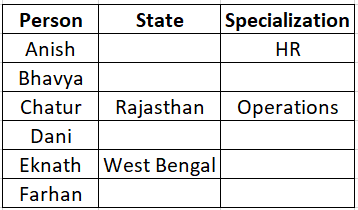
Now from statement 5 we know that the person from Maharashtra is pursuing Finance.
It is given that Bhavya is not pursuing Finance and Dani is not from Maharashtra.
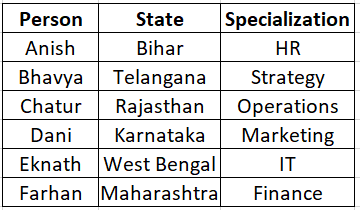
From this we can infer that Farhan is from Maharashtra and is pursuing Finance.
Now we know that Eknath and Bhavya are not pursuing Marketing.
This means that Dani is pursuing Marketing.
Now we can conclude that Bhavya is from Telangana and is pursuing Strategy.
Now the completely filled table will be as shown below.
Study the following information carefully and answer the given questions.
Six friends Anish, Bhavya, Chatur, Dani, Eknath and Farhan are from six different states among Telangana, Maharashtra, Rajasthan, West Bengal, Karnataka and Bihar in no particular order. Further each of the friends is pursuing a different specialization among Marketing, Finance, Operations, Strategy, HR and IT. Additionally it is known that:
1) Anish is pursuing HR
2) Eknath is from West Bengal
3) Person from Telangana is pursuing Strategy
4) Chatur is from Rajasthan and is pursuing Operations
5) Person from Maharashtra is pursuing Finance
6) Bhavya is not pursuing Finance
7) Dani is not from Maharashtra or Bihar
8) Eknath and Bhavya are not pursuing Marketing
Who is pursuing Strategy?
Let us try to tabulate the given information.
From the given hints we can form a partially filled table as shown below.
Now from statement 5 we know that the person from Maharashtra is pursuing Finance.
It is given that Bhavya is not pursuing Finance and Dani is not from Maharashtra.
From this we can infer that Farhan is from Maharashtra and is pursuing Finance.
Now we know that Eknath and Bhavya are not pursuing Marketing.
This means that Dani is pursuing Marketing.
Now we can conclude that Bhavya is from Telangana and is pursuing Strategy.
Now the completely filled table will be as shown below.
Study the following information carefully and answer the given questions.
Six friends Anish, Bhavya, Chatur, Dani, Eknath and Farhan are from six different states among Telangana, Maharashtra, Rajasthan, West Bengal, Karnataka and Bihar in no particular order. Further each of the friends is pursuing a different specialization among Marketing, Finance, Operations, Strategy, HR and IT. Additionally it is known that:
1) Anish is pursuing HR
2) Eknath is from West Bengal
3) Person from Telangana is pursuing Strategy
4) Chatur is from Rajasthan and is pursuing Operations
5) Person from Maharashtra is pursuing Finance
6) Bhavya is not pursuing Finance
7) Dani is not from Maharashtra or Bihar
8) Eknath and Bhavya are not pursuing Marketing
Which specialization is Dani pursuing?
Let us try to tabulate the given information.
From the given hints we can form a partially filled table as shown below.
Now from statement 5 we know that the person from Maharashtra is pursuing Finance.
It is given that Bhavya is not pursuing Finance and Dani is not from Maharashtra.
From this we can infer that Farhan is from Maharashtra and is pursuing Finance.
Now we know that Eknath and Bhavya are not pursuing Marketing.
This means that Dani is pursuing Marketing.
Now we can conclude that Bhavya is from Telangana and is pursuing Strategy.
Now the completely filled table will be as shown below.
Five friends, P, Q, R, S, and T, attended a series of five conferences in different cities: New York, London, Tokyo, Paris, and Sydney. Each friend attended a conference in a different city, and they attended the conferences on different days of the week: Monday, Tuesday, Wednesday, Thursday, and Friday. We have the following information about which person attended which conference and on which day:
1. P attended the conference in Sydney
2. T attended the conference on Friday and Q attended the conference in Paris.
3. The person who attended the Tokyo conference did so on Wednesday.
4. S and Q attended the conference on consecutive days and none went to Tokyo.
Who attended the conference in New York?
We have the following table to fill according to the arrangement:
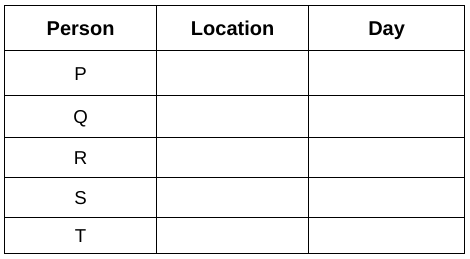
According to the statement 2, T attended the conference on Friday but not in New York and Q attended the conference in Paris
Further, statement 3 says that the person who attended the Tokyo conference did so on Wednesday.
Now, according to statement 4, S and Q attended the conference on consecutive days and none of them attended the conference on Tokyo. Therefore, none of them would have attended the conference on Wednesday. Hence, they attended the conference on Monday and Tuesday or they attended on Thursday and Friday.
However, T attended the conference on Thursday and Friday. Hence, S and Q must have attended the conference on Monday and Tuesday.
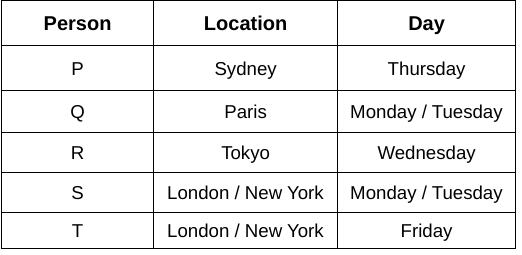
According to statement 1, P attended the conference in Sydney, he must have attended the conference on Thursday. Hence, R is left so he/she must have attended the conference on Wednesday in Tokyo.
Now, we are left with S and T to uniquely identify the locations. The remaining locations are London or New York so they must have attended at one of the location.
With this, we have the following table:
Five friends, P, Q, R, S, and T, attended a series of five conferences in different cities: New York, London, Tokyo, Paris, and Sydney. Each friend attended a conference in a different city, and they attended the conferences on different days of the week: Monday, Tuesday, Wednesday, Thursday, and Friday. We have the following information about which person attended which conference and on which day:
1. P attended the conference in Sydney
2. T attended the conference on Friday and Q attended the conference in Paris.
3. The person who attended the Tokyo conference did so on Wednesday.
4. S and Q attended the conference on consecutive days and none went to Tokyo.
On which day R attended the conference?
We have the following table to fill according to the arrangement:
According to the statement 2, T attended the conference on Friday but not in New York and Q attended the conference in Paris
Further, statement 3 says that the person who attended the Tokyo conference did so on Wednesday.
Now, according to statement 4, S and Q attended the conference on consecutive days and none of them attended the conference on Tokyo. Therefore, none of them would have attended the conference on Wednesday. Hence, they attended the conference on Monday and Tuesday or they attended on Thursday and Friday.
However, T attended the conference on Thursday and Friday. Hence, S and Q must have attended the conference on Monday and Tuesday.
According to statement 1, P attended the conference in Sydney, he must have attended the conference on Thursday. Hence, R is left so he/she must have attended the conference on Wednesday in Tokyo.
Now, we are left with S and T to uniquely identify the locations. The remaining locations are London or New York so they must have attended at one of the location.
With this, we have the following table:
Five friends, P, Q, R, S, and T, attended a series of five conferences in different cities: New York, London, Tokyo, Paris, and Sydney. Each friend attended a conference in a different city, and they attended the conferences on different days of the week: Monday, Tuesday, Wednesday, Thursday, and Friday. We have the following information about which person attended which conference and on which day:
1. P attended the conference in Sydney
2. T attended the conference on Friday and Q attended the conference in Paris.
3. The person who attended the Tokyo conference did so on Wednesday.
4. S and Q attended the conference on consecutive days and none went to Tokyo.
S attended the conference on which day?
We have the following table to fill according to the arrangement:
According to the statement 2, T attended the conference on Friday but not in New York and Q attended the conference in Paris
Further, statement 3 says that the person who attended the Tokyo conference did so on Wednesday.
Now, according to statement 4, S and Q attended the conference on consecutive days and none of them attended the conference on Tokyo. Therefore, none of them would have attended the conference on Wednesday. Hence, they attended the conference on Monday and Tuesday or they attended on Thursday and Friday.
However, T attended the conference on Thursday and Friday. Hence, S and Q must have attended the conference on Monday and Tuesday.
According to statement 1, P attended the conference in Sydney, he must have attended the conference on Thursday. Hence, R is left so he/she must have attended the conference on Wednesday in Tokyo.
Now, we are left with S and T to uniquely identify the locations. The remaining locations are London or New York so they must have attended at one of the location.
With this, we have the following table:
Five friends, P, Q, R, S, and T, attended a series of five conferences in different cities: New York, London, Tokyo, Paris, and Sydney. Each friend attended a conference in a different city, and they attended the conferences on different days of the week: Monday, Tuesday, Wednesday, Thursday, and Friday. We have the following information about which person attended which conference and on which day:
1. P attended the conference in Sydney
2. T attended the conference on Friday and Q attended the conference in Paris.
3. The person who attended the Tokyo conference did so on Wednesday.
4. S and Q attended the conference on consecutive days and none went to Tokyo.
If S went to London on Tuesday, Q went to _____________ ?
We have the following table to fill according to the arrangement:
According to the statement 2, T attended the conference on Friday but not in New York and Q attended the conference in Paris
Further, statement 3 says that the person who attended the Tokyo conference did so on Wednesday.
Now, according to statement 4, S and Q attended the conference on consecutive days and none of them attended the conference on Tokyo. Therefore, none of them would have attended the conference on Wednesday. Hence, they attended the conference on Monday and Tuesday or they attended on Thursday and Friday.
However, T attended the conference on Thursday and Friday. Hence, S and Q must have attended the conference on Monday and Tuesday.
According to statement 1, P attended the conference in Sydney, he must have attended the conference on Thursday. Hence, R is left so he/she must have attended the conference on Wednesday in Tokyo.
Now, we are left with S and T to uniquely identify the locations. The remaining locations are London or New York so they must have attended at one of the location.
With this, we have the following table:
Read the following information carefully and answer the questions which follow.
Pawan, Rohit, Sanjay, Tushar, Umesh and Vivek are 6 friends who belong to 6 different cities among Allahabad, Hyderabad, Delhi, Lucknow, Guwahati and Bhopal, not necessarily in the same order. During their summer break they decided to visit some other city. Each one of them went to one of the cities from the above list. No two friends visited the same city. Further, the following information is also known
1. Tushar is from Guwahati and Pawan visited Allahabad.
2. Umesh is from Delhi and Sanjay visited Lucknow.
3. Rohit is not from Allahabad and Vivek is not from Hyderabad.
4. Rohit visited Tushar’s hometown and Vivek visited Umesh’s hometown.
5. The person who is from Hyderabad visited Lucknow.
Four of the following five pairs are similar in some way. Choose the pair which is not similar to the other four.
We know that Tushar is from Guwahati and Umesh is from Delhi.
Now Pawan visited Allahabad so, Pawan cannot be from Allahabad. Thus, one among, Rohit, Sanjay and Vivek has to be from Allahabad. However, from 3 we can rule out Rohit. Thus, either Sanjay or Vivek will be from Allahabad. However, from 2 and 5 we can infer that Sanjay is from Hyderabad and visited Lucknow. Thus, Vivek must be from Allahabad. One among Rohit and Pawan will be from Bhopal and the other one will be from Lucknow.
Now we know that Pawan visited Allahabad, Sanjay visited Lucknow, Rohit visited Guwahati and Vivek visited Delhi. Thus one among Tushar and Umesh will visit Hyderabad and the other one will visit Bhopal.
Thus we have the following table
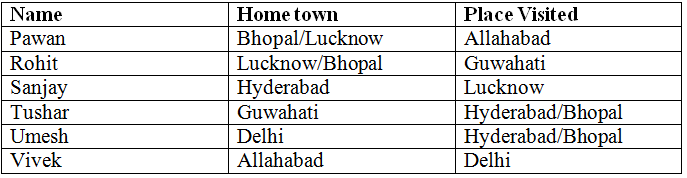
All options represent the person and the city he visited. This is not followed in option A. Hence A is the odd one out.
Read the following information carefully and answer the questions which follow.
Pawan, Rohit, Sanjay, Tushar, Umesh and Vivek are 6 friends who belong to 6 different cities among Allahabad, Hyderabad, Delhi, Lucknow, Guwahati and Bhopal, not necessarily in the same order. During their summer break they decided to visit some other city. Each one of them went to one of the cities from the above list. No two friends visited the same city. Further, the following information is also known
1. Tushar is from Guwahati and Pawan visited Allahabad.
2. Umesh is from Delhi and Sanjay visited Lucknow.
3. Rohit is not from Allahabad and Vivek is not from Hyderabad.
4. Rohit visited Tushar’s hometown and Vivek visited Umesh’s hometown.
5. The person who is from Hyderabad visited Lucknow.
For how many people can their home town and the city they visited be uniquely determined?
We know that Tushar is from Guwahati and Umesh is from Delhi.
Now Pawan visited Allahabad so, Pawan cannot be from Allahabad. Thus, one among, Rohit, Sanjay and Vivek has to be from Allahabad. However, from 3 we can rule out Rohit. Thus, either Sanjay or Vivek will be from Allahabad. However, from 2 and 5 we can infer that Sanjay is from Hyderabad and visited Lucknow. Thus, Vivek must be from Allahabad. One among Rohit and Pawan will be from Bhopal and the other one will be from Lucknow.
Now we know that Pawan visited Allahabad, Sanjay visited Lucknow, Rohit visited Guwahati and Vivek visited Delhi. Thus one among Tushar and Umesh will visit Hyderabad and the other one will visit Bhopal.
Thus we have the following table
Read the following information carefully and answer the questions which follow.
Pawan, Rohit, Sanjay, Tushar, Umesh and Vivek are 6 friends who belong to 6 different cities among Allahabad, Hyderabad, Delhi, Lucknow, Guwahati and Bhopal, not necessarily in the same order. During their summer break they decided to visit some other city. Each one of them went to one of the cities from the above list. No two friends visited the same city. Further, the following information is also known
1. Tushar is from Guwahati and Pawan visited Allahabad.
2. Umesh is from Delhi and Sanjay visited Lucknow.
3. Rohit is not from Allahabad and Vivek is not from Hyderabad.
4. Rohit visited Tushar’s hometown and Vivek visited Umesh’s hometown.
5. The person who is from Hyderabad visited Lucknow.
Who is from Allahabad?
We know that Tushar is from Guwahati and Umesh is from Delhi.
Now Pawan visited Allahabad so, Pawan cannot be from Allahabad. Thus, one among, Rohit, Sanjay and Vivek has to be from Allahabad. However, from 3 we can rule out Rohit. Thus, either Sanjay or Vivek will be from Allahabad. However, from 2 and 5 we can infer that Sanjay is from Hyderabad and visited Lucknow. Thus, Vivek must be from Allahabad. One among Rohit and Pawan will be from Bhopal and the other one will be from Lucknow.
Now we know that Pawan visited Allahabad, Sanjay visited Lucknow, Rohit visited Guwahati and Vivek visited Delhi. Thus one among Tushar and Umesh will visit Hyderabad and the other one will visit Bhopal.
Thus we have the following table
Read the following information carefully and answer the questions which follow.
Pawan, Rohit, Sanjay, Tushar, Umesh and Vivek are 6 friends who belong to 6 different cities among Allahabad, Hyderabad, Delhi, Lucknow, Guwahati and Bhopal, not necessarily in the same order. During their summer break they decided to visit some other city. Each one of them went to one of the cities from the above list. No two friends visited the same city. Further, the following information is also known
1. Tushar is from Guwahati and Pawan visited Allahabad.
2. Umesh is from Delhi and Sanjay visited Lucknow.
3. Rohit is not from Allahabad and Vivek is not from Hyderabad.
4. Rohit visited Tushar’s hometown and Vivek visited Umesh’s hometown.
5. The person who is from Hyderabad visited Lucknow.
Who is from Bhopal?
We know that Tushar is from Guwahati and Umesh is from Delhi.
Now Pawan visited Allahabad so, Pawan cannot be from Allahabad. Thus, one among, Rohit, Sanjay and Vivek has to be from Allahabad. However, from 3 we can rule out Rohit. Thus, either Sanjay or Vivek will be from Allahabad. However, from 2 and 5 we can infer that Sanjay is from Hyderabad and visited Lucknow. Thus, Vivek must be from Allahabad. One among Rohit and Pawan will be from Bhopal and the other one will be from Lucknow.
Now we know that Pawan visited Allahabad, Sanjay visited Lucknow, Rohit visited Guwahati and Vivek visited Delhi. Thus one among Tushar and Umesh will visit Hyderabad and the other one will visit Bhopal.
Thus we have the following table
In XYZ company, six employees—A, B, C, D, E, and F—belong to different teams: Tech, Marketing, Design, Networking, Accounts, and Sales, not necessarily in the same order. Each employee visits the office on a different day from Monday to Saturday. The following details are known about the six employees.
1) A who belongs to Tech team doesn't visit on Thursday and C is not from marketing and did not visit on Friday.
2) E is from Accounts team and B visits on Saturday. While employee from Design did not visit on Saturday.
3) The employee from sales team visits on Monday and the employee from Network team visits on Friday.
4) Employee from Tech and sales visited on consecutive days while the employees from Tech and Design did not.
On which day did E visit the office?
We will write down the direct information given above.
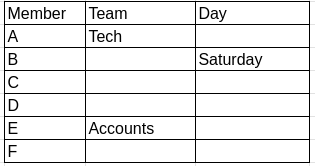
We are told that employee from sales team visits on Monday. And the employee from Network team visits on Friday.
We are also told that A didn't visit on Thursday. So, the only possible days that A would can visit Tuesday or Wednesday. Statement 4 says that Tech and sales Visited on consecutive days. So, the only possibitlity for Tech is Tuesday.
We are also told that tech and sales team visited on consecutive days. So, Tech team employee visited on Tuesday.
We are told that Teach and Design team didn't visit on consective days. So, Design team employee didn't visit on Wednesday.
The only possibility for Design team employee will be thursday. Hence Marketing employee will be on Saturday.
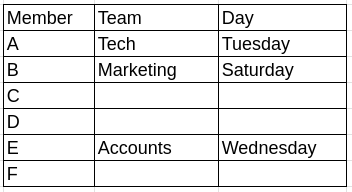
Wednesday is the correct answer.
In XYZ company, six employees—A, B, C, D, E, and F—belong to different teams: Tech, Marketing, Design, Networking, Accounts, and Sales, not necessarily in the same order. Each employee visits the office on a different day from Monday to Saturday. The following details are known about the six employees.
1) A who belongs to Tech team doesn't visit on Thursday and C is not from marketing and did not visit on Friday.
2) E is from Accounts team and B visits on Saturday. While employee from Design did not visit on Saturday.
3) The employee from sales team visits on Monday and the employee from Network team visits on Friday.
4) Employee from Tech and sales visited on consecutive days while the employees from Tech and Design did not.
How many different combinations of team and visiting day are possible for the six employees?
We will write down the direct information given above.
We are told that employee from sales team visits on Monday. And the employee from Network team visits on Friday.
We are also told that A didn't visit on Thursday. So, the only possible days that A would can visit Tuesday or Wednesday. Statement 4 says that Tech and sales Visited on consecutive days. So, the only possibitlity for Tech is Tuesday.
We are also told that tech and sales team visited on consecutive days. So, Tech team employee visited on Tuesday.
We are told that Teach and Design team didn't visit on consective days. So, Design team employee didn't visit on Wednesday.
The only possibility for Design team employee will be thursday. Hence Marketing employee will be on Saturday.
We know that C didn't visit on Friday. So, C can't be from Networking. C is either from Sales or from Design.
Not the remaining two can be given to D and F in two ways.
So, 2*2 = 4 ways.
In XYZ company, six employees—A, B, C, D, E, and F—belong to different teams: Tech, Marketing, Design, Networking, Accounts, and Sales, not necessarily in the same order. Each employee visits the office on a different day from Monday to Saturday. The following details are known about the six employees.
1) A who belongs to Tech team doesn't visit on Thursday and C is not from marketing and did not visit on Friday.
2) E is from Accounts team and B visits on Saturday. While employee from Design did not visit on Saturday.
3) The employee from sales team visits on Monday and the employee from Network team visits on Friday.
4) Employee from Tech and sales visited on consecutive days while the employees from Tech and Design did not.
If F is from sales team which team does D belong to?
We will write down the direct information given above.
We are told that employee from sales team visits on Monday. And the employee from Network team visits on Friday.
We are also told that A didn't visit on Thursday. So, the only possible days that A would can visit Tuesday or Wednesday. Statement 4 says that Tech and sales Visited on consecutive days. So, the only possibitlity for Tech is Tuesday.
We are also told that tech and sales team visited on consecutive days. So, Tech team employee visited on Tuesday.
We are told that Teach and Design team didn't visit on consective days. So, Design team employee didn't visit on Wednesday.
The only possibility for Design team employee will be thursday. Hence Marketing employee will be on Saturday.
We know that C didn't visit on Friday. So, C can't be from Networking. C is either from Sales or from Design.
We are told that F is from Sales. So, C will be from marketing. Hence, D will be from Networking.
