The average of four consecutive odd numbers is 24. What is the average of the squares of the largest and the smallest of the four numbers?
MAH MBA CET Average, Ratio, and Proportions Questions
The average = 24. So, the numbers are 24 - 3, 24 - 1, 24 + 1 and 24 + 3.
ie. 21, 23, 25, 27
So, the sum of squares = $$21^2 + 27^2 = 441+729 = 1170$$
Hence, the average is $$1170/2 = 585$$
The average weights of students in two sections of a class are 40 kg and 42 kg respectively. If the number of students in the two sections are in the ratio 3 : 4, find the average weight of the class.
Let the number of students in the two sections be 3k and 4k.
Total weight of the class = 3k * 40 + 4k * 42 = 120k + 168k = 288k
So, average weight of the class = 288k/(3k + 4k) = 288/7 = 41.14 kg
Ram and Shyam started a business by investing Rs. 60000 and Rs. 40000 respectively at the start of the year. Ram withdrew Rs. 40000 after 6 months. They agreed to split the profit in the ratio of the average monthly investment basis. If they received Rs. 6000 as the profit at the end of the year, then find out Ram’s share in the profit?
Average monthly investment made by Ram = $$\dfrac{60000*6 + 20000*6}{12}$$ = Rs. 40000
Average monthly investment made by Shyam = Rs. 40000
Hence Ram’s share = $$\dfrac{40000}{40000+40000}\times 6000$$ = Rs. 3000
Therefore, we can say that option E is the correct answer.
A solution containing alcohol and water in the ratio 7 : 2 is mixed with twice the amount of another solution containing alcohol and water in the ratio 5 : 1. What is the percentage of alcohol in the final mixture?
Let 9 litres of the first solution be mixed with 18 litres of the second solution.
Therefore, total volume of the solution = (9 + 18) litres = 27 litres
Quantity of alcohol in the first solution = $$\dfrac{7}{9} * 9$$ litres = 7 litres
Quantity of alcohol in the second solution = $$\dfrac{5}{6} * 18$$ litres = 15 litres
Total quantity of alcohol = (7 + 15) litres = 22 litres
% of milk = $$\dfrac{22}{27} * 100\% = 81.48\%$$
Hence, option E is the correct answer.
A milk and water solution has milk and water in the ratio 4:1. After adding 40 ml of water the ratio of milk and water becomes 2:1. What is the total volume of the solution now?
Let the initial volume of the solution be 5V out of which milk is 4V and water is V.
After adding 40 ml water the ratio becomes 2:1. So we get,
$$\frac{4V}{V+40}=\frac{2}{1}$$
$$=>V=40$$ ml
So the volume of the solution now = 5V+40 = 5*40+40 = 240 ml
Hence Option C.
Solutions A and B have concentrations of Sulphuric acid as 20% and 50% respectively. In what ratio must A and B be mixed to get a solution of concentration 40%?
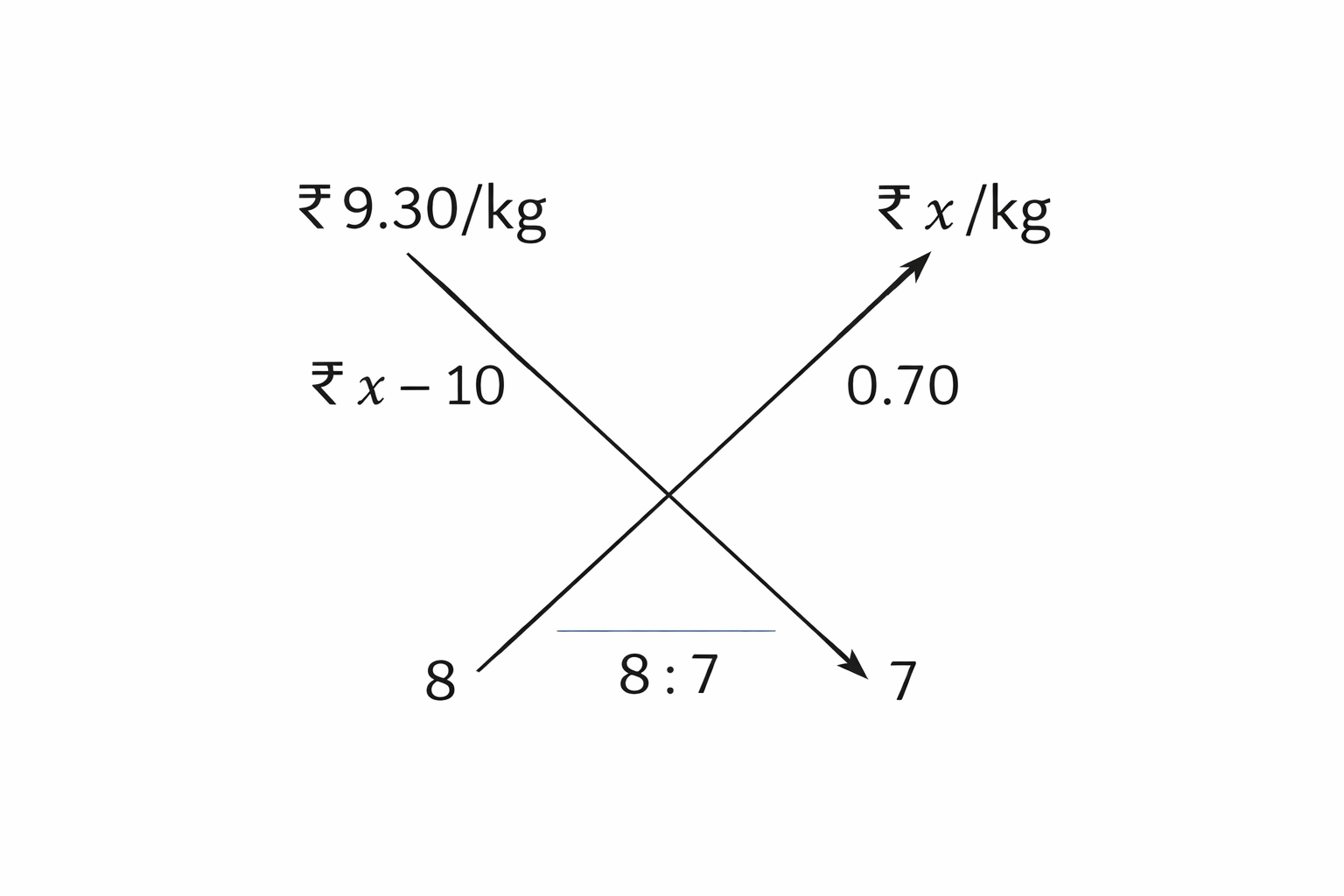
By applying the formula of alligation we get,
20 50
\ /
40
/ \
10 20
Thus the solutions A and B must be mixed in the ratio 10:20 = 1:2.
A certain number of chocolates were distributed in a classroom containing 15 boys and 25 girls. The number of chocolates each boy gets is equal to 20% of the number of girls and the number of chocolates each girl gets is equal to 15% of the total number of students in the class. Find the total number of chocolates.
Number of chocolates each boy gets = 0.2*25 = 5
==> Total number of chocolates distributed among boys = 5*15 = 75
Number of chocolates each girl gets = 0.15*(15+25) = 6
==> total number of chocolates distributed among girls = 6*25 = 150
==> Total number of chocolates distributed in the class = 150+75 = 225
In an examination, a student is required to get 360 marks to pass in the exam. A student scores 32% of the maximum marks and is declared fail by 88 marks. Find the maximum marks a student can score.
Let the maximum marks be x.
32% of x = 360-88
8/25 of x = 272
x = 850
A barrel is initially filled with pure single malt whiskey. A distiller follows a process to infuse another type of whiskey by removing 10% of the barrel's contents and replacing it with blended malt whiskey. The distiller plans to sell the whiskey once the percentage of single malt drops below 65%. Determine the minimum number of times this operation must be performed.
Let's say the contents of the barrel is X litres, and 10% is being taken out and being replaced every operation,
That means there's 90% of the barrel's contents intact after every operation.
So, if we start off with X litres of single malt whiskey, after the first operation we will have 0.9X of single malt whiskey,
And after n operations the contents of single malt whiskey will be $$0.9^nX$$
And we want this value to be lesser than 0.65X
After 4 operations the content will be 0.6561X
So, a minimum of 5 operations must be performed
The average age of a group of 6 sisters decreases by 12 years immediately when a pair of twins is born. What is the total age of all 8 siblings immediately after the birth of the twins?
Let the average of all the sisters before the birth of the pair of twins is X.
So, the sum of their ages = 6X
When the pair of twins born, the sum of their ages would remain the same.
Hence, the average of their ages when the pair of twins born = 6X/8 or 3X/4
So, the average decreased by 12 i.e. X - 3X/4 = 12
X/4 = 12
Or, X = 48
Therefore, the sum of their ages when the pair of twins born = 6*48 = 288
An alcohol brand BE contains alcohol and water in ratio 3:5, and brand RE contains alcohol and water in ratio 4:1. In what ratio these two should be mixed such that the mixture has equal quantity of water and alcohol?
Let the volume of BE be 8m and volume of RE be 5n.
The concentration of alcohol in the mixture is $$\frac{\left(3m+4n\right)}{\left(8m+5n\right)}=\frac{1}{2}$$
6m+8n = 8m+5n
3n = 2m
m:n = 3:2
We need 8m:5n = $$\frac{8}{5}\cdot\frac{3}{2}\ =\frac{12}{5}$$
Rice types A, B, and C cost 30, 40, and 45 rupees per kg. In what ratio should a shopkeeper mix A:B:C to get a profit of 2.5 rupees when selling one kg of mixture at the price of type B?
The selling price is the same as the price of type B, which is 40 rupees per kg.
The profit on 1 kg is given to be 2.5 rupees, giving the cost price of 1 kg of the mixture to be 37.5 rupees.
We need to mix 30, 40 and 45 in a ratio of 37.5 rupees per kg.
We can eliminate option A, as that would be simply $$\frac{30+40+45}{3}=\frac{115}{3}=38.33$$ rupees per kg.
We need to look for what option could lead to a price of 37.5 rupees per kg.
Option B, on mixing A and B, would give a mixture of 35 rupees per kg, which, when combined with 2 units of type C, gives a mixture worth 40 rupees per kg (2 units of 35 and 2 units of 45)
Option C gives the correct answer. Mixing two units of type A and 1 unit of type C would give three units of mixture worth 35 rupees per kg, using alligation. These 3 units, when mixed with 3 units of type B, would give an average of 35 and 40, which is 37.5 rupees per kg.
Option D on mixing B and C will give a mixture worth 42.5 rupees per kg, which, when combined with two units of type A, gives a final mixture worth 36.25 rupees per kg.
Option E on mixing A and B will give a mixture worth 35 rupees per kg, which, when mixed with 5 unit of type 45, this will be more than the mid-point of 40, and hence can be eliminated.
Therefore, Option C is the correct answer.
A bartender initially serves the customer 60% concentrated alcohol. Every time the customer finishes 50% of the drink, the bartender refills it with a 20% solution up to the brim. After how many refills, will the alcohol concentration of the drink be less than 22%?
Thinking about the problem, when the bartender refills the drink, 50% of the glass is with current concentration, and the other 50% (the one being filled) is 20%, since both are equal in quantities, the resulting concentration would be the mid-point between the two concentrations, or the average of the two values.
1st refill (20+60)/2 = 40%
2nd refuill (20+40)/2 = 30%
3rd refill (20+30)/2 = 25%
4th refill (20+25)/2 = 22.5%
5th refill (20+22.5)/2 = 21.25%
Hence, after the 5th refill, the concentration would be less than 22%
Therefore, Option D is the correct answer.
A dishonest tailor uses an incorrect measuring tape to get 10% more fabric while buying. He uses a different measuring tape that gives 20% less fabric than promised when selling. If the stated selling price is the same as the cost price, what is his overall profit or loss percentage?
Suppose the tailor buys 100x meters of cloth.
In actuality, he gets 100x * 1.1 = 110x m of cloth.
Further, when selling he sells, 20% less fabric so if a person asks him 100x of cloth, he would sell him only 80x.
Hence, the total profit made by him = (110x/80x - 1) * 100 = 37.5%
Anisha shared 60% of her chocolate bars in the ratio 5:7 between her two cousins and kept the remaining bars for herself. Had she distributed the entire collection in the ratio 1:1:1 among her cousins and herself, she would have received 160 grams less chocolate. What was the total weight of the chocolate bars?
Let the total weight of her chocolate bar is 120X.
She distributed 60% of it among her cousins I.e. 60% of 120X = 72X
So, she received 120X - 72X = 48X
Now, if she distributed in equal ratio, then each one would have received 40X and Anisha would have received 150 grams less chocolate.
Or, 48X - 40X = 8X
8X = 160 grams
X = 20 grams
Hence, total weight = 120*20 = 2.4 Kg
A company's stock price decreased by 20% on Monday, 50% on Tuesday, 3% on Wednesday, and increased by 50% on Thursday and 20% on Friday. What can be concluded about the stock price at the end of Friday compared to the beginning of Monday?
Let's take the sock price on Monday start to be 100
Using the multiplication factor for all the increases and decreases through the week, we get:
$$100\times\ \frac{4}{5}\times\ \frac{1}{2}\times\ 0.97\times\ \frac{3}{2}\times\ \frac{6}{5}$$
$$97\times\ \frac{18}{25}$$
This would be less than 97.
Hence, Option A would be the correct answer.
Anmol states, "18% of the first number is equivalent to 45% of the second number. What percentage of the second number does 63% of the first number represent?
Let the two numbers be Y and Z, such that
18% of Y = 45% of Z
Then, 63% of Y = ? % of Z
18% of Y = 45% Z
63% of Y = ? % of Z
∴ 18 x ? = 45 x 63
∴ ? = 45 x 63 = 157.5%
So answer is 157.5% of Z