Read the information given below and answer the 3 associated questions.
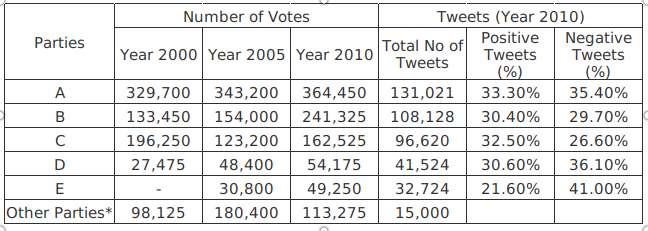
During 2015-2019, the revenues of four companies P-S were as follows:

Sign in
Please select an account to continue using cracku.in
↓ →
XAT data change over a period questions focus on analyzing trends and variations in data across different time frames. These questions often involve tables, graphs, or charts depicting data points over months, quarters, or years, requiring candidates to identify patterns, calculate growth or decline rates, and draw logical conclusions. To check similar important topics, checking with the XAT syllabus will help you understand better and plan your preparation accordingly.
Along with this, we recommend you to solve questions from XAT previous papers. This will help you in knowing the question types and various type of questions being asked in the actual exam. We've compiled all the questions with detailed solutions from previous exams to help you with your preparation. You could download them as PDF and solve them as per your convenience.
Read the information given below and answer the 3 associated questions.
During 2015-2019, the revenues of four companies P-S were as follows:
Which of the given companies has seen the highest year-on-year growth (in percentage) in any single year during this five-year period?
By noticing the table, we can come to the conclusion that either P in 2018 or Q in 2017 must-have the highest YoY growth.
YOY of P from 2017 to 2018=50/200 *100=25%
YOY of Q from 2016 to 2017 = 40/140 *100 = 28.57%
Hence D is the correct answer.
Read the information given below and answer the 3 associated questions.
During 2015-2019, the revenues of four companies P-S were as follows:
It was discovered later that one of the companies misreported its revenue of one of the years. If the misreported revenue is replaced by the correct revenue, the revenues of that company over the five-year period will be in an arithmetic progression. The company that misreported its revenue was
Let us observe the revenue of the four companies over four years. We see that Company Q and Company S can form an arithmetic progression. This is because the differences between revenues over the years are different, and we are only looking to replace one value over five years to achieve an arithmetic progression.
Looking at Company P, we see that it maintains a +25 over the years except for one year. If 2018 revenue was 225, then we would achieve an arithmetic progression.
Similarly, for Company S, we see that it maintains a +20 over the years except for one year. If 2018 revenue were 160, then we would achieve an arithmetic progression.
Read the information given below and answer the 3 associated questions.
During 2015-2019, the revenues of four companies P-S were as follows:
During the period from 2014 to 2015, the revenue increased by 25% for three of the companies and by 50% for the remaining company. The total increase in revenue, for all four companies put together, was Rs. 125 lakhs.
Which of the following CANNOT be true?
Let us first compute the individual changes in value in both years before zeroing in on the companies that fall into the 25% increase and 50% increase groups.
For 25% increase:

For 50% increase:

We can move forth with the assumption that P saw a 50% increase while the rest of the companies saw a 25% increase. In this case, the total increase in revenue, for all four companies put together, will be Rs. 125 lakhs. Same is the case when we consider company R to have seen a 50% increase, while the rest had a 25% increase. {Hence, Option D is true} We observe that Options B, C and E hold true as well. The increase observed for each of the companies is distinct, based on the given condition. Thus, Option A cannot be true.

Educational materials for CAT preparation

.png)
.png)