Group
Group
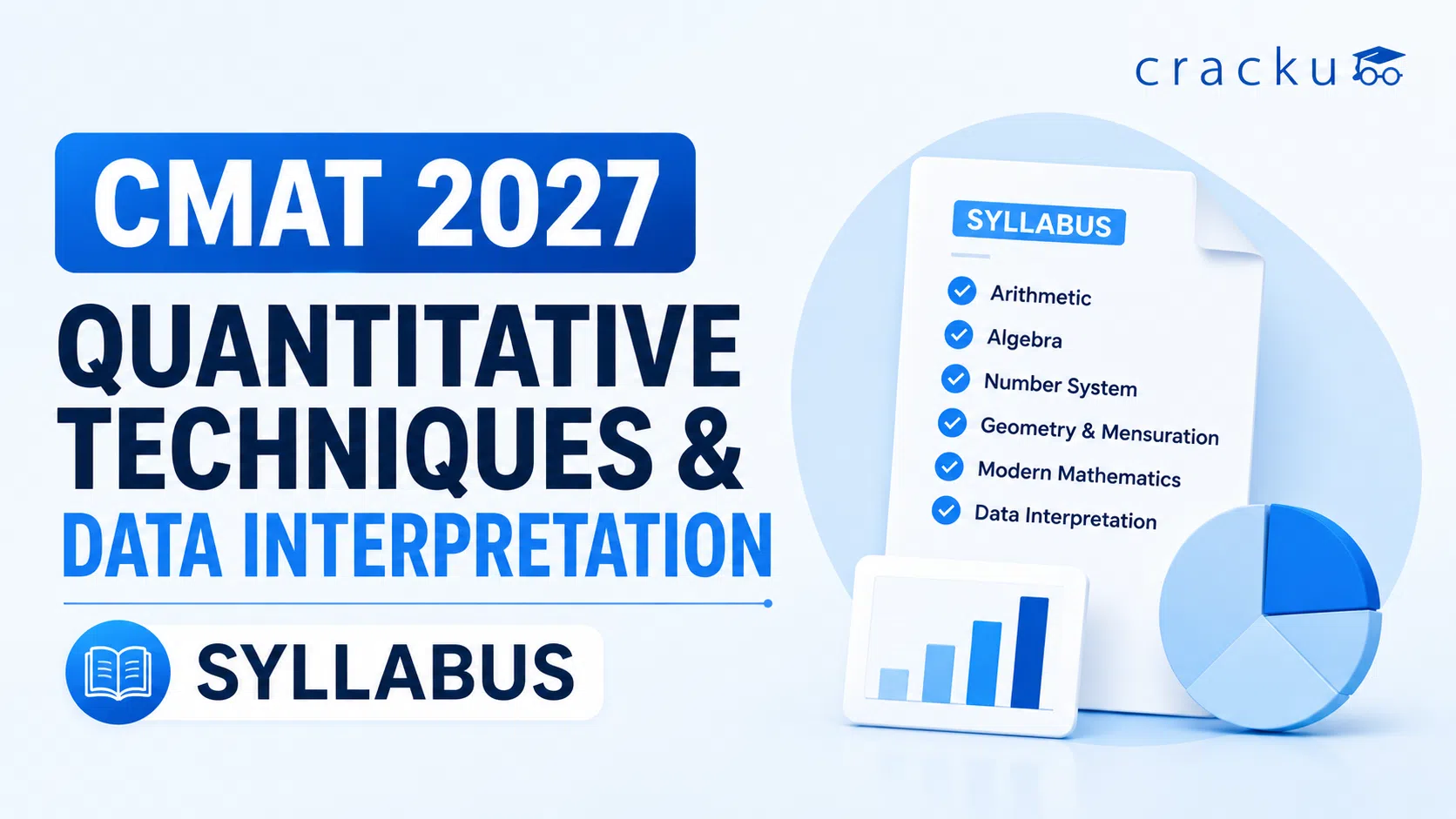
The CMAT Quantitative Techniques & Data Interpretation Syllabus 2027 evaluates candidates’ mathematical aptitude, problem-solving ability, and data analysis skills. The section includes important topics such as Arithmetic, Algebra, Geometry, Data Interpretation, Tables, Graphs, and Charts. Understanding the latest CMAT Quantitative Techniques & Data Interpretation syllabus 2027 helps students identify high-weightage topics and build effective preparation strategies for scoring well in the CMAT exam.
CMAT Quantitative Techniques & Data Interpretation Syllabus 2027
The Quantitative Techniques & Data Interpretation section of the CMAT 2027 covers Arithmetic and Algebra. The difficulty level of this section is usually moderate. The following table lists the topics covered in this section of the CMAT syllabus:
Topics | Key chapters covered |
Arithmetic | Percentages, Profit & Loss, Ratio & Proportion, Simple & Compound Interest, Time-Speed-Distance, Work & Time, Pipes & Cisterns, Alligation & Mixtures |
Algebra | Linear Equations, Quadratic Equations, Inequalities, Logarithms, Surds |
Number System | Remainders, HCF-LCM, Divisibility, Unit/Last two Digit |
Geometry & Mensuration | Triangles, Circles, Centres, Polygons. |
Modern Mathematics | Probability, Permutations & Combinations, Binomial Theorem |
Data Interpretation | Tables, Line Graphs, Pie Charts, Bar Graphs |
Statistics | Mean, Median, Mode |
CMAT Quantitative Techniques & Data Interpretation Syllabus PDF
The official CMAT Quantitative Techniques and Data Interpretation syllabus PDF for 2027 has not yet been released. Candidates may look at the previous year's syllabus PDF to better understand the relevant topics and exam pattern. The CMAT 2027 Quantitative Techniques & Data Interpretation syllabus is expected to include topics such as arithmetic, algebra, geometry, number system, modern maths, data interpretation - tables, graphs, pie charts. Click on the CMAT Quantitative Techniques & Data Interpretation Syllabus PDF link to download the detailed syllabus PDF for CMAT 2027 and start your preparation strategically.
CMAT Quantitative Techniques & Data Interpretation: Important Topics 2027
The CMAT Quantitative Techniques & Data Interpretation section is considered one of the most important sections of the exam. This section evaluates the applicant's mathematical knowledge, calculation skills, and ability to correctly understand data.
The CMAT 2027 QTDI syllabus is expected to cover topics such as Arithmetic, Algebra, Geometry, Number System, Modern Maths, and Data Interpretation. Candidates must focus on important topics and practise frequently in order to improve their speed, accuracy, and overall exam performance.
Arithmetic
Algebra
Number System
Geometry
Data Interpretation (DI)
Read Also, CMAT Eligibility Criteria 2027, Reservation, Age Limit
CMAT Quantitative Techniques & Data Interpretation: Preparation Strategy 2027
Below are a few important strategies to help students in their preparation:
Master basics first: Cover arithmetic, basic algebra and geometry fully. These topics provide the best return on time invested.
Practice DI sets: Get familiar with interpreting charts fast by practising 3-4 question sets per day at the start.
Time yourself: As there is no section-wise timer, take full-length mock tests and practise switching sections based on difficulty.
Drop the calculator habit: Improving your mental maths skills and learning approximate rounding, simplifying fractions early, and using percentage shortcuts will save you minutes in every test.
Work on question types: Match-the-following, arrange-in-order, and statement-type questions need practice patterns. Solving a lot of previous years' questions reduces the time required to answer each question.
Use shortcuts selectively: Practise the elimination technique to make a smart guess on a few questions. Learn shortcut tricks and try to solve questions in different ways while practising. Take advantage of the options to find the correct solution. However, avoid overusing tricks that increase complexity.
Read Also, CMAT Important Topics 2027, Section-wise Preparation Strategy
CMAT Quantitative Techniques & Data Interpretation: Exam Pattern 2027 (Expected)
The Quant & DI section combines traditional quantitative topics with data interpretation. Below in the table is the CMAT Quantitative Techniques & Data Interpretation Exam Pattern 2027 so that students can plan their strategy well before the exam and score well.
Section Name | Quantitative Techniques & Data Interpretation |
Total Questions | 20 Questions |
Total Marks | 80 Marks |
Question Type | Multiple Choice Questions (MCQs) |
Exam Mode | Computer-Based Test (CBT) |
Sectional Time Limit | No Section-Wise Time Limit |
Time Management | Candidates can manage and switch between sections freely during the exam |
Marks for Correct Answer | +4 Marks |
Negative Marking | -1 Mark for Incorrect Answer |
Calculator Usage | Calculators are Not Allowed |
Preparation Strategy | Focus on manual calculations, shortcuts, approximation techniques, and strong mathematical basics |
Major Topics Covered | Arithmetic, Algebra, Geometry, Number System, Modern Maths, Data Interpretation - Tables, Graphs, Charts, |
Skills Tested | Mathematical Ability, Problem-Solving, Data Analysis, Speed & Accuracy |
Conducting Body | National Testing Agency (NTA) |
CMAT Quantitative Techniques & Data Interpretation: Difficulty Level
The CMAT Quantitative Techniques & Data Interpretation section for 2027 is expected to have a moderate to difficult difficulty level. Questions are likely to be asked from arithmetic, algebra and DI sets. The section may be calculation-intensive and time-consuming, requiring strong conceptual clarity, speed, and accuracy for a good score.
Read Also, CMAT Registration 2027, Important Dates, Steps To Fill, Fees
CMAT Quantitative Techniques & Data Interpretation Syllabus 2027 : Conclusion
The CMAT Quantitative Techniques & Data Interpretation Syllabus 2027 covers all the major mathematical and analytical topics required for management entrance exam preparation. Candidates should focus mainly on Arithmetic, Algebra, Geometry, Number System, and Data Interpretation as these areas consistently carry significant weightage in the exam.
A strong preparation strategy that includes conceptual learning, regular practice, mock tests, and speed improvement can help students score well in the CMAT QTDI section. Consistency, time management, and smart shortcut techniques will play a crucial role in maximizing accuracy and overall exam performance.