Question 1
Who is a Fabian Entrepreneur?
Sign in
Please select an account to continue using cracku.in
↓ →
Who is a Fabian Entrepreneur?
A Fabian entrepreneur is an entrepreneur who is cautious and sceptical of new or innovative ways of doing business or is reserved in adopting new technology. This is best captured in B, which is the correct answer.
Given below are two statements: One is labelled as Assertion (A) and the other is labelled as Reason (R).
Assertion (A): The management of technological innovation is usually required under circumstances with increased vagueness, uncertainty and risk, and companies are giving importance to it.
Reasons (R): Given that technological innovation is for many companies a primary way of competition in the twenty-first century, its management is an activity of vital importance.
In light of the above statements, choose the most appropriate answer from the options given below:
The assertion (A) notes that managing technological innovation is circumstantially required with increased vagueness, uncertainty, and risk inherent, but companies are still giving importance to it. The reason (R) attempts to explain it by saying that companies have no choice but to manage technological innovation, as it is the primary way of competition for many companies today. Since the reason (R) offers a valid explanation to the assertion (A) by emphasising the importance of managing innovation to companies, the correct answer is option A.
Match List I with List II :
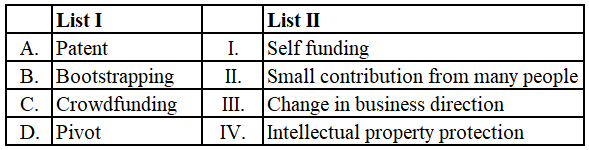
Choose the correct answer from the options given below :
A patent is a type of intellectual property that gives its owner the legal right to exclude others from making, using, or selling an invention for a limited period in exchange for publishing an enabling disclosure of the invention. Bootstrapping is where entrepreneurs start companies with minimal capital, using personal finances or operating revenues instead of external investments. Crowdfunding is funding a project or venture by raising money from many people, typically via the internet. In business, pivoting is a term that describes the process of changing direction when the current strategy is not delivering the desired results.
Based on the summary provided above, the most suitable sequence of pairs is provided in option B.
Given below are two statements: One is labelled as Assertion (A) and the other is labelled as Reason (R).
Assertion (A): Bootstrapping entrepreneurship is one of the most adopted forms of entrepreneurship in India.
Reasons (R): Managing a business through one's own financial resources is the first and easiest option available for the entrepreneur to start a business.
In light of the above statements, choose the most appropriate answer from the options given below :
The assertion (A) notes that bootstrapping, the process of building a business from scratch without attracting investment or with minimal external capital, has become one of the most adopted forms of entrepreneurship in India. It hints at the fact that many Indian entrepreneurs prefer to start their businesses with their own monetary input without taking external capital. The reason (R) attempts to explain (A) by saying that the first and easiest option for an entrepreneur to start a business is by bootstrapping it. Since (R) might be a reason why bootstrapping is the most adopted form of entrepreneurship, it can be said to be a correct explanation. The correct answer, therefore, is option A.
Which term refers to the initial phase of a startup when it starts to develop its product?
Ideation refers to the process of developing and conveying prescriptive ideas to others, typically in a business setting. It describes the sequence of thoughts, from the original concept to implementation. Pivoting is the action that a business or a startup takes to find a new footing in a changing business landscape, and it cannot be a process a startup goes through in its initial days. Scaling is essentially growing your revenue without significantly affecting costs. This cannot be a process that takes place during the early days of a startup. Bootstrapping is where entrepreneurs start companies with minimal capital, using personal finances or operating revenues instead of external investments. Still, since this might not apply to all startups, the best answer is option A, ideation.
Given below are two statements :
Statement I: An intrapreneur operates within a large organisation to drive innovation.
Statement II: An intrapreneur is the same as an entrepreneur, working independently to start a new business.
In light of the above statements, choose the most appropriate answer from the options given below :
An intrapreneur is an employee who acts like an entrepreneur while working within an established company, using the organisation's resources to develop new products, services, or processes. Statement I is correct. Statement II does not align with this definition, and is incorrect. The correct answer is option C.
Given below are two statements: one is labelled as Assertion (A) and the other is labelled as Reason (R) :
Assertion (A): Venture capital investment helps nurture innovative entrepreneurship in India.
Reason (R): The venture capital investment is a risk financing generally available in the form of equity or quasi-equity, like a convertible loan instrument, for supporting startups.
In light of the above statements, choose the most appropriate answer from the options given below:
Given below are two statements: one is labelled as Assertion (A) and the other is labelled as Reason (R) :
Assertion (A): Apart from 'Mind Mapping', 'Reverse thinking', 'Brainstorming', and 'Brainwriting', technology has made it easier to generate quality ideas for innovation and entrepreneurship.
Reason(R): "Ideas are the building blocks for all innovation. They are what we work on, so the first step in starting anything new is finding that idea. We must make use of the different tools and techniques available to us to come up with quality ideas."
In light of the above statements, choose the most appropriate answer from the options given below :
Given below are two statements:
Statement I: Incremental innovation is concerned with the gradual improvement of existing products, services, processes, competitive positions, and organisational paradigms.
Statement II: Radical innovation involves a much higher risk than incremental innovation.
In light of the above statements, choose the most appropriate answer from the options given below:
Match List I with List II :
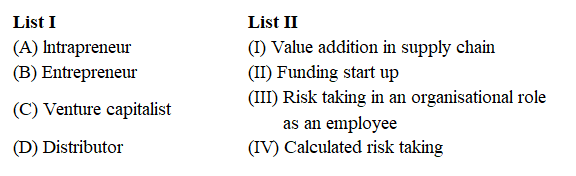
Choose the correct answer from the opt ions given below :
An intrapreneur is an employee tasked with developing innovative ideas or projects within a company. In contrast, an entrepreneur is an individual who creates and/or invests in one or more businesses, bearing most of the risks and enjoying most of the gains. A venture capitalist is an investor who provides capital to early-stage, high-growth potential companies in exchange for equity (ownership). VCs often offer business expertise and guidance in addition to funding, typically investing in privately held companies that are not yet ready to go public. A distributor acts as an intermediary in the supply chain, purchasing products in bulk from manufacturers and selling them to retailers or end consumers.
The most suitable pairing based on the summary provided above is in option C, which is the correct answer.
Given below are two statements:
Statement I: A business incubator typically takes an equity stake in the startups it supports.
Statement II: A business incubator provides early-stage companies with office space, mentorship, and resources in general to support them.
In light of the above statements, choose the correct answer from the options given below:
Given below are two statements:
Statement I: A startup's valuation is usually lower during the seed funding stage compared to later stages.
Statement II: Venture capital is typically the first source of funding for most startups.
In light of the above statements, choose the correct answer from the options given below:
Seed stage funding is the initial capital a startup receives to get from the idea stage to a viable business model, typically used for product development, market research, and initial operations. For various reasons, including investor interests and startup maturity, it is usual for startups to have lower valuations during the seed funding stage. Statement I is correct. Additionally, the earliest funding stages for a startup often involve internal resources or personal networks before a company can attract a Venture Capital firm. Statement II is incorrect. The correct answer is option C.
Match List I with List II:
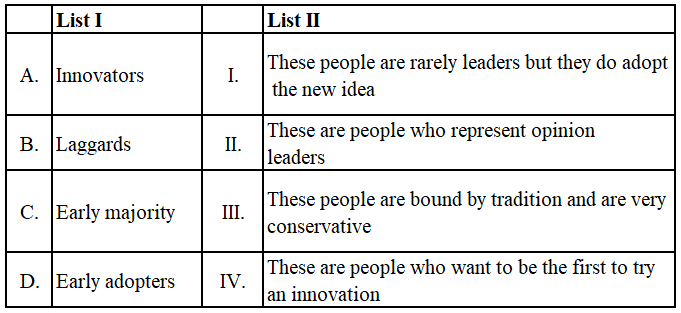
Choose the correct answer from the options given below :
An innovator is a person who develops a new design, product, or idea, or who has new ideas about how to do something. A laggard is someone who takes more time than necessary or someone who lags behind. The early majority is the first sizable segment of a population to adopt a new or innovative technology. In contrast, the early adopters are persons or businesses that acquire a new product or technology before others.
Based on the summary provided above, the most suitable pairs are provided in option C, which is the correct answer.
Feasibility analysis may be processed as follows.
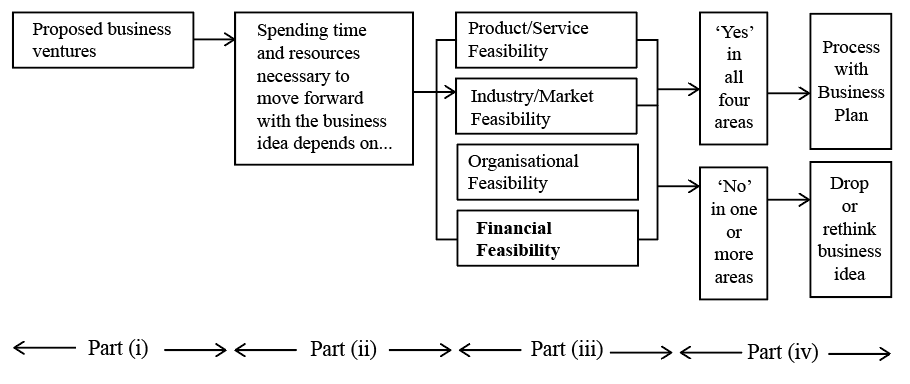
Venture Capital financing is ___________
(A) Type of financing by venture capital.
(B) It is private equity capital provided as seed funding to early-stage.
(C) Investment in blue-chip companies for an assured return.
(D) It is a high-risk investment made with the intention of creating high returns.
(E) Done in technology projects only.
Choose the correct answer from the options given below :
Venture capital financing is a type of private equity investing specific to earlier-stage businesses that require capital. In return, the investor receives an equity stake in the business through the issuance of some type of security instrument. The financing is naturally high risk as the involved businesses are still in the nascent stage.
Statements A and B both align with the summary above. Statement C talks about blue-chip companies and is irrelevant. Statement D also aligns with the discussion on high risk. Statement E narrows down the ambit of venture capital financing to technology projects, and is wrong.
The correct answer is option B.
Which of the following is the primary purpose of a 'pitch deck' ?
A pitch deck is a concise presentation that businesses and startups use to give a high-level overview of their company to potential investors, partners, or clients. This is best captured in option B, which is the correct answer.
An entrepreneur is a person who
Option A, although not the definition of an entrepreneur, captures the core drive of an entrepreneur. Options B and C are incorrect; an entrepreneur neither works for a firm nor a company, nor takes instructions as a subordinate. Option D, although somewhat true, is not true exclusively of entrepreneurs. The correct answer is option A.
Read the following statements carefully and respond to the question that follows.
A. In the given situation, a manufacturing plant may be an example of a business incubator.
B. Fixed monthly income is an advantage of entrepreneurship.
C. A shared workspace offering resources and support to new startups is known as a business incubator.
D. Only youngesters may become entrepreneurs.
E. Only an experienced middle-aged person may start a business.
Choose the correct answer from the options given below:
In a given situation, a manufacturing plant might indeed host a business incubator. Statement A's validity can be held for a while. Statement B is false; entrepreneurship is for people willing to take risks and accept that incomes may not be stable. Statement C is true; the very definition of a business incubator describes it as a workspace that offers resources and support to new startups. Statement D is false; whether or not a person can be an entrepreneur is independent of their age, caste, gender, or social stature. Option E, following the same reasoning as D, is also false.
The statement C is true, while the statement A might be true. Statements B, D, and E are all false. Option D is the correct answer.
Given below are two statements
Statement I: Innovation, defined as the creation or adoption of new ideas, products, services, programs, technology, policy, structure, or administrative systems, is acknowledged as a source of sustained competitive advantage for many organisations.
Statement II: The innovation adoption process does not depend upon the 'initiation stage,' which includes recognition of a need, knowledge acquisition, initial attitude formation, and innovation selection.
In light of the above statements, choose the correct answer from the options given below:
Statement I can be said to be true: Innovation is about finding creative solutions to commonplace problems or problems that traditional solutions solve only inefficiently. Innovation is indeed the creation or adoption of new ideas, products, services, programs, technology, policy, structure, or administrative systems.
Statement II is false: Adopting innovation is not a blind endeavour in business settings; it requires thorough analysis of requirements and feasibility.
The correct answer, therefore, should be option C. Statement I is true, but statement II is false.
Match List I with List II :
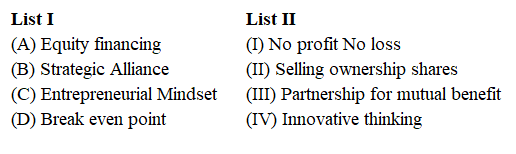
Choose the correct answer from the options given below :
Equity financing is the process of raising capital for a business by selling shares of ownership to investors. A strategic alliance is a formal agreement between two or more independent companies to work together and share resources to achieve common business objectives. An entrepreneurial mindset requires cultivating innovative ideas that are feasible, useful, and original. A break-even point refers to a point where the cost-to-revenue ratio is 1:1, i.e. when there's no profit or loss.
The correct pairings, therefore, are
Option C is the correct answer.
Which four of the following are entrepreneurial strategies?
A. Investing money for safe and secured return
B. "Being fastest with the mostest"
C. Reform, rather than revolutionise
D. Finding and occupying a specialized "ecological niche"
E. Validate and adapt your business model
Choose the correct answer from the options given below :
One of the essential characteristics of an entrepreneur is an acceptance of risk and a willingness to take risks in the capital landscape. (A) is wrong as it goes against the risk-taking mindset. All other characteristics provided in the question are, in one way or another, essential aspects of being an entrepreneur. Since B, C, D, and E follow, the correct answer is option D.
Given below are two statements :
Statement I: Pivoting in a startup context refers to changing the business model or strategy in response to market feedback.
Statement II: Pivoting always involves changing the target market essentially.
In light of the above statements, choose the correct answer from the options given below:
In business, pivoting is a strategic change in a company's direction, product, or business model in response to market conditions, customer needs, or other external factors. Statement I describes pivoting correctly and is true. Statement II describes a mechanism by which a business actualises pivoting, saying that it is 'essential' that a business change the target market while pivoting, which is wrong. While changing the target market can be one of the things that an organisation does while pivoting, it need not be essential or compulsory. Statement II is wrong. The correct answer is option C.
Which of the following funding sources is specifically aimed at helping early-stage startups?
Let's define each of the terms in the options as follows:
The most suitable answer for "funding sources is specifically aimed at helping early-stage startups" is option B, 'angel investment'.
Match List I with List II :
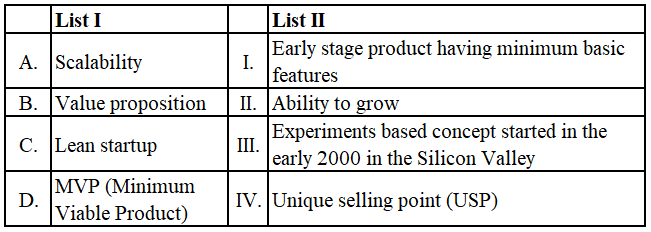
Choose the correct answer from the options given below :
Scalability is the ability of an organisation or a company to handle a growing amount of work or demand without sacrificing performance, quality, or efficiency. A value proposition is a clear statement that explains the specific measurable benefits a customer receives from a company's product or service. Lean startup is a methodology for developing businesses and products that aims to shorten product development cycles and rapidly discover if a proposed business model is viable. A minimum viable product (MVP) is the most basic version of a product that a company can release to early customers to gather feedback and validate its core idea.
Based on the summary provided above, the most suitable list of pairs is provided in option D, which is the correct answer.
The concept of a venture capitalist may be simplified as:
Choose the correct answer from the options given below:
A venture capitalist (VC) (can be me or you) can be described as an investor who provides capital to early-stage, high-growth potential companies (can be you or me, but not me myself or you yourself) in exchange for equity or ownership. Both 2 (your idea and my money) and 4 (my idea and your money) directly follow, and option A is the correct answer.
Given below are two statements: one is labelled as Assertion (A) and the other is labelled as Reason (R):
Assertion (A): Business accelerators are set up with the primary objective to offer mentorship and resources to speed up the growth of startups.
Reason (R): Most of the startups face difficulties and challenges in their growth stage.
In light of the above statements, choose the most appropriate answer from the options given below:
The assertion (A) provides us with the fact that business accelerators are set up with the primary objective of offering mentorship and resources to speed up the growth of startups. The fact that business accelerators are making investments in the growth of startups hints towards two things being the reasons why the planners would have gone ahead with the accelerators:
The reason (R) is a reasonable explanation for the two points listed above. It explains that the startups need help because they face difficulties and challenges in their growth stage. It also explains that planners can probabilistically hope for success because 'most' startups face such challenges.
Therefore, reason (R) is the correct explanation for assertion (A) and option A is the correct answer.
Becoming an entrepreneur is more about
Option D is the correct answer.
Entrepreneurship involves much more than financial resources or external factors like support. The mindset is the most crucial factor, as it drives innovation, resilience, and the ability to take calculated risks. While commitment, money, and support can contribute, the entrepreneur's mindset ultimately determines their success.
Social Enterprise Obligation includes :
(A) Environment
(B) Fair Business Practices
(C) Community Involvement
(D) Energy
(E) Shareholder's Profit
Choose the correct answer from the options given below :
Design thinking has following important stages. Arrange in a sequence.
(A) Define
(B) Empathize
(C) Prototype
(D) Test
(E) Ideate
Choose the correct answer from the options given below:
Option A is the correct answer. Correct Sequence is B → A → E → C → D
The Design Thinking process consists of the following stages in sequence:
Empathize (B): Understand the needs and perspectives of the users.
Define (A): Clearly articulate the problem based on insights gathered.
Ideate (E): Brainstorm potential solutions to the defined problem.
Prototype (C): Create tangible representations of the ideas to explore solutions.
Test (D): Test the prototypes with users to refine and improve the solution.
Match List-I with List-II

Choose the correct answer from the options given below :
Option c) (A) - (II), (B) - (III), (C) - (I), (D) - (IV). is the correct answer.
Intrapreneur → Risk-taking in an organisational role (II): An intrapreneur is an individual within an organization who takes initiative and risks to innovate or implement ideas within the company.
Entrepreneur → Calculated Risk-taking (III): Entrepreneurs are individuals who take calculated risks to start and run businesses, aiming for profit and growth.
Distributor → Value Addition (I): Distributors play a crucial role in adding value by bridging the gap between manufacturers and consumers, ensuring products reach the market.
Customer → Utility Maximisation (IV) : Customers aim to maximise their utility or satisfaction by choosing products or services that best meet their needs and preferences.
Critical evaluation points of Entrepreneurship Development Programmes (EDPs) are:
(A) Organisational Policies
(B) Suitable selection procedure of trainees and Faculty
(C) Quality of Technical and Vocational Education and Training
(D) Organisation associated in the EDP
Choose the correct answer from the options given below :
Let us evaluate the stated factors:
A: Effective organisational policies guide the strategic direction and alignment of EDPs with developmental objectives.
B: Proper selection ensures that the right candidates and qualified instructors participate, improving program relevance and effectiveness.
C: High-quality training equips participants with practical skills and knowledge for entrepreneurial success.
D: The organisation associated with the EDP may influence its effectiveness, but it is not a critical factor for evaluating the program’s success. The primary focus should remain on internal factors like policies, selection, and training quality.
We observe that A, B and C are key factors that need to be considered. Hence, Option C is the correct answer.
Match List-I with List-II

Choose the correct answer from the options given below :
The correct answer here is Option D: (A) - (III), (B) - (IV), (C) - (II), (D) - (I).
(A) - (III): Availability of raw materials, machinery, etc., falls under technical feasibility, as it ensures that the required inputs and resources for production are technically viable.
(B) - (IV): Demand and customer preferences are related to market feasibility, as they determine the product’s market acceptance.
(C) - (II): Profit projections relate to financial feasibility, as they evaluate whether the business can sustain itself financially.
(D) - (I): A business plan integrates market, technical, and financial feasibility, summarizing the overall strategy for the business.
Following are the reasons of the success of entrepreneurial ventures
(A) Effective Market Research
(B) Good Financial Control
(C) Good Management
(D) Caste of Entrepreneur
(E) Good Idea
Choose the correct answer from the options given below :
The correct answer is A, B, C, and E, as these are critical factors for the success of entrepreneurial ventures:
Effective Market Research (A): Understanding market needs, target audience, and competition is vital to identify opportunities and tailor offerings accordingly.
Good Financial Control (B): Proper financial management ensures optimal allocation of resources, cash flow stability, and the ability to adapt to market challenges.
Good Management (C): Strong leadership and efficient management drive strategic decision-making, team performance, and operational success.
Good Idea (E): A strong and innovative idea is the foundation of any entrepreneurial venture, providing the value proposition that attracts customers and investors.
The caste of the entrepreneur (D) is irrelevant in determining business success. Success is driven by skills, strategies, and execution, not by socio-cultural factors.
Entrepreneurial success is rooted in actionable factors like market research, financial control, management skills, and innovative ideas (A, B, C, and E). Attributes like caste (D) do not impact the ability to create or grow a successful venture and have no bearing on the universal principles of entrepreneurship.
Therefore, the correct answer is option C.
The entrepreneur :
The entrepreneur is best described by both (1) and (2) because:
Entrepreneurs do more than just create businesses. They embody the spirit of innovation (A) and individuality (B), which are essential in navigating dynamic and competitive business environments. Together, these traits highlight their multifaceted role.
Therefore, the correct answer is option D.
Given below are two statements :
Statement I: Dividing the market in small niches is known as targeting.
Statement II: Segmentation and targeting are essential components of understanding the market and tap it effectively.
In the light of the above statements, choose the correct answer from the options given below:
Statement I: Dividing the market into small niches is not targeting. Instead, dividing the market into small niches is segmentation. Targeting comes after segmentation, where the marketer selects the specific segments to focus on. So, Statement I is false.
Statement II: Segmentation and targeting are indeed essential components of understanding and tapping the market effectively. Segmentation helps in identifying different customer groups, while targeting helps in selecting the right group to focus marketing efforts on. Statement II is true.
Which of the following is an example of speculative business risk?
Speculative risk business refers to the type of risk that involves the possibility of either a gain or a loss. Unlike pure risk, which only involves the potential for loss (such as property damage or injury), speculative risk allows for the possibility of both positive and negative outcomes.
According to the question, A special promotion fails to increase the sales is an example of a speculative risk business because there is a possibility of either gaining or losing (in this case, the company might not achieve the desired sales increase). Speculative risks involve outcomes that can result in both profits and losses, which is the nature of this situation.
A corporate manager who starts a new initiative for their company/organisation which entails setting up a new distinct business unit can be regarded as :
An intrapreneur is a corporate manager or employee who takes the initiative within an organization to create a new business unit, product, or service. They act like entrepreneurs but work within the structure and resources of an existing organization. Intrapreneurs bring innovative ideas to life while leveraging the company's support.
Ecopreneur: Focuses on environmental sustainability and creates businesses that contribute to ecological well-being.
Technopreneur: An entrepreneur who specializes in technology-based ventures.
Businessman/Businesswoman: Refers to individuals engaged in traditional business operations, typically outside the scope of intrapreneurship.
Hence, answer is Option C lntrapreneur
Handson learning can be best taught through.
(A) Case study analysis
(B) Entrepreneurial Audit
(C) Entrepreneurial profiling
(D) Class discussion
(E) Focused group discussion
Choose the correct answer from the options given below :
The correct answers are A, B, and C because they all involve practical and hands-on approaches to learning:
Case Study Analysis (A): This helps students engage with real-world situations, understand problems, and come up with solutions. It’s an effective way to apply theoretical knowledge in a practical context.
Entrepreneurial Audit (B): This involves examining real businesses to understand their strengths, weaknesses, and operations. It gives learners direct exposure to how businesses work in practice.
Entrepreneurial Profiling (C): By studying the journeys and strategies of successful entrepreneurs, students gain real insights into decision-making, challenges, and the mindset required to succeed.
All three methods focus on active learning and practical application, making them ideal for hands-on learning.
Shaadi.com, an online match making service is an example of following start up model
Shaadi.com, as an online matchmaking service, primarily operates on a subscription-based business service model, where users pay a fee to access premium features or services such as enhanced profile visibility, direct messaging, or personalized matchmaking assistance. This model generates revenue by charging users for ongoing access to its services.
The primary function of a new age entrepreneur is innovation. This statement was/is proposed and propagated by :
Joseph Schumpeter, an economist, is well-known for his theory on entrepreneurship, where he emphasized the role of innovation as the primary function of an entrepreneur. He introduced the concept of "creative destruction," where new innovations disrupt existing markets and drive economic growth. Schumpeter highlighted that entrepreneurs are key agents of innovation in the economy.
Given below are two statements :
Statement I: Business ideation is important aspect of venture creation.
Statement II: Conversation that happens in an elevator is known as elevator pitch.
In the light of the above statements, choose the most appropriate answer from the options given below :
Statement I: Business ideation is important aspect of venture creation.
This statement is true. Business ideation refers to the process of coming up with and developing ideas for a new business or product. It is a critical step in venture creation because without a solid idea, it's difficult to build a successful business. Business ideation involves identifying market needs, potential solutions, and the core vision for the business.
Statement II: Conversation that happens in an elevator is known as elevator pitch
The elevator pitch is not simply any conversation that happens in an elevator. It specifically refers to a brief, persuasive speech that is designed to spark interest in a person, idea, product, or project. The term "elevator pitch" comes from the idea that the pitch should be short enough to be delivered during a brief elevator ride—typically lasting between 30 seconds to 2 minutes. Hence, not true.
Hence, Statement I is correct but Statement II is incorrect
Which of the following statements are correct?
(A) MUDRA loans under PMMY include Shishu Category
(8) MUDRA loans under PMMY include Kishore Category
(C) MUDRA loans under PMMY include Shaishav Category
(D) MUDRA loans under PMMY include Tarun Category
(E) MUDRA loans under PMMY include Vyask Category
Choose the correct answer from the options given below:
The Pradhan Mantri MUDRA Yojana (PMMY) provides loans to micro and small enterprises under three categories:
Hence, the answer is (A), (B) and (D) only
Along with goal setting, major concerns for a growing enterprise are
(A) Time management.
(B) Finding, retaining and motivating able human resource
(C) Finding new financers
(D) Diversification and export potential
(E) Performance measurement and incentives
Choose the correct answer from the options given below :
(C) Finding new financers
(D) Diversification and export potential
These are not mandatory for a thriving business that is growing, this is probably applicable for a certain fraction of businesses.
Whereas the other three options, (A), (B), (E) are all essential for growing enterprises.
Arrange the following stages of Entrepreneurship Creativity in sequence.
(A) Knowledge accumulation
(B) Incubation
(C) Implementation
(D) Idea experience
(E) Evaluation
Choose the correct answer from the options given below:
The stages of Entrepreneurship Creativity are logically sequenced as follows:
Thus, the correct sequence is (A), (B), (D), (E), (C).
Scaling up of a business requires a firm to take care of following things :
(A) Hiring, retaining and motivating qualified employees
(B) Finding investors who share same goals
(C) Time management and work assignment ability
(D) Adequate market potential and opportune time
(E) Business idea experiencing
Choose the correct answer from the options given below:
Let's consider each statement
(A) Hiring and retaining talent is one of the most crucial things a business needs to do when scaling up. When scaling, an organisation can not afford to lose its top employees and needs to hire good talent to handle the additional responsibilities that would come with expansion.
(B) Also becomes essential, scaling up often requires resources, for which investors are looked for. The investor must share the same goal for the organisation; otherwise, it would lead to problems in the functioning and decision-making of the business down the line.
(C) Scalin up requires a change in the structure of the organisation and responsibilities for a majority of the workforce; managing how the employees spend their time and what work they are assigned becomes a crucial aspect in times of expansion.
(D) It is also crucial to consider the market position before expanding a business; hence, this must be considered.
(E) Although this is a valid point to consider during the early stages of a company, how the business idea is planned out is done when the organization is in its initial phases, whether it is a smaller company or a start-up. Although checking the feasibility of scaling is also relevant from an expansion perspective, the "idea experience" is more about how the business actually would work.
Further, no option includes all five statements, and of the given statements, E is the least relevant from a scaling perspective.
Thereofre Optoin C is the correct answer.
Which of the following factors are not relevant for judging the adequacy of market?
Labour market indirectly affect market adequacy by influencing production capabilities, an hence are useful in judging how adequate is the market.
Domestic and export demand are similarly useful in giving an idea of how big the market is.
While competitors and their market shares provide insight into the competitive landscape, they do not directly determine the adequacy of the market itself. Hence is not a relevant factor.
Therefore, Option D is the correct answer.
Design thinking involves which of the following stages?
(A) Prototyping
(B) Define
(C) Empathise
(D) Modelling
(E) Test
Choose the correct answer from the options given below :
Option b) (A), (B), (C) and (E) only is the correct answer.
The design thinking process typically involves the following key stages:
Given below are two statements :
Statement I: Changing competition in market place is the primary reason for govt involvement in business globally.
Statement II: Increase in cost of production is the primary reason for govt in business globally.
In the light of the above statements, choose the most appropriate answer from the options given below :
Option C is the correct answer. Statement I is correct but Statement II is incorrect
Statement I: Changing competition in the marketplace can indeed drive government involvement in businesses globally. Governments may intervene to ensure fair competition, prevent monopolies, protect consumer interests, and promote economic stability. This makes Statement I correct.
Statement II: While an increase in production costs might lead businesses to seek government support (e.g., subsidies or incentives), it is not the primary reason for government involvement. Governments typically get involved to regulate the market, ensure equitable distribution of resources, or address market failures, not just to manage production costs. This makes Statement II incorrect.
Diffusion of Innovation theory is associated with
E.M. Rogers developed the Diffusion of Innovation theory, which identifies five key adopter categories: innovators, early adopters, early majority, late majority, and laggards. The theory also describes factors such as the innovation's relative advantage, compatibility, complexity, trialability, and observability, which influence its diffusion.
Which of the following is NOT part of Entrepreneurship Development Programme?
Entrepreneurship Development Programmes (EDPs) focus on identifying and selecting potential entrepreneurs, enhancing their capabilities through training, and developing their entrepreneurial mindset. Though they address entrepreneurial skills and strategies, they do not directly involve arranging infrastructural capabilities, which are external, logistical concerns typically handled by other agencies or partnerships. Hence, Option D is the best choice.
The Government of India has launched the following initiative a few years ago to drive the new age ideas and enterprises :
The Government of India launched the Start-Up India initiative in 2016 to foster innovation, encourage entrepreneurship, and support new-age ideas and enterprises. This program focuses on building a robust startup ecosystem by providing financial support, simplifying regulations, and promoting collaboration between startups and government or private entities.
A) Production Linked Incentive (PLI): A scheme to boost domestic manufacturing and exports in specific sectors by linking incentives to production. It targets established industries rather than startups.
B) Special Economic Zone (SEZ): Focuses on promoting exports and investments by creating industrial zones with favourable economic laws but not directly aimed at startups.
C) Technology Development Board: Provides financial assistance for commercializing indigenous technologies but is not a comprehensive startup ecosystem program.
Therefore, the correct answer is option D.
Which of the following statements are correct?
(A) SMILE loans are aimed pursue growth opportunities
(B) SMILE loans are aimed to pay for the earlier loan
(C) SMILE loans are available to both manufacturing and services organisations.
(D) SMILE loans are aimed at setting upstate of the Art manufacturing infrastructure for MSME
(E) SMILE loans are aimed at meeting the consumption needs of farm-based entrepreneurs.
Choose the correct answer from the options given below :
The correct answer is A, C, and D, as these align with the objectives of SMILE (SIDBI Make in India Loan for Enterprises) loans.
(A) SMILE loans are aimed at pursuing growth opportunities:
SMILE loans are designed to help businesses, particularly in the MSME sector, seize growth opportunities by providing funding for expansion and modernization.
(C) SMILE loans are available to both manufacturing and services organizations:
The scheme supports enterprises in both manufacturing and service sectors, ensuring broad applicability across industries.
(D) SMILE loans are aimed at setting up state-of-the-art manufacturing infrastructure for MSMEs:
The program focuses on funding projects that involve advanced manufacturing setups to enhance productivity and competitiveness.
(B) SMILE loans are aimed to pay for earlier loans: Incorrect, as SMILE loans are not designed for refinancing or debt repayment but for new investments.
(E) SMILE loans are aimed at meeting the consumption needs of farm-based entrepreneurs: Incorrect, as SMILE loans are not for consumption or farm-based needs but for MSME infrastructure development and growth.
SMILE loans specifically cater to the "Make in India" initiative, supporting MSMEs in manufacturing and services with funding for new investments and infrastructure upgrades (A, C, and D). The other options (B and E) misrepresent the purpose of the program, which is not for refinancing or meeting consumption needs.
Therefore, the correct answer is option B.
Given below are two statements :
Statement I :
People's attitudes have changed over the years leading to involvement of State (Government) in businesses globally.
Statement II :
Increasing technicality is leading to State (Government) to make interventions in businesses globally.
In the light of the above statements, choose the most appropriate answer from the options given below :
Statement I: "People's attitudes have changed over the years leading to involvement of State (Government) in businesses globally."
This statement is misleading because while people’s attitudes have indeed evolved, the increased involvement of the state in business globally is more driven by economic, social, and political factors rather than just changes in people's attitudes.
Statement II: "Increasing technicality is leading to State (Government) to make interventions in businesses globally."
This statement is also incorrect in its phrasing. While increasing technical complexity in industries may be necessary for certain government interventions (like regulations for safety, intellectual property, etc.), the statement makes it sound as though the main driver of state intervention is the technical complexity itself, which is not entirely accurate.
The legal term for brand is
The legal term for a brand is Trademark.
A trademark is a legally recognized symbol, design, word, or combination of these that identifies and distinguishes the products or services of one business from others. It provides legal protection to the brand, ensuring that no one else can use a similar mark that could cause confusion in the marketplace.
Match List I with List II :

Choose the correct answer from the options given below:
Plant and Machinery Records is related to Technical feasibility.
Profit Statements is related to Financial feasibility.
Creativity and Innovation is related to Business ideation.
Empathize is related to Design thinking.
Which of the following is NOT a form of organisation to initiate a business/enterprise?
The correct answer is "Live and License" because it is not a recognized form of business organization.
Sole Proprietorship: This is the simplest form of business, where a single individual owns and manages the enterprise.
Partner Organization: In this setup, two or more individuals come together to run a business and share profits, responsibilities, and liabilities.
Private Limited Company: This is a registered company with limited liability for its shareholders, often chosen for scalability and credibility.
On the other hand, "Live and License" does not pertain to business structuring. It usually refers to property agreements, such as a rental contract, and has no relevance to initiating a business or enterprise.
Bottom line measures of social performance for an entrepreneur include the following
(A) Unemployment rate
(B) Relative Poverty
(C) GDP Growth
(D) Average Commute Time
(E) Illiteracy Rate
Choose the correct answer from the options given below :
An entrepreneur's bottom-line measures of social performance should reflect their impact on society and community well-being, such as employment, poverty reduction, and education.
Of the given options, bottom lines measures of social performance would include:
A: Unemployment rate- Entrepreneurs create jobs and reduce unemployment.
B: Relative Poverty - Entrepreneurship can help reduce poverty by increasing income.
D: Average Commute Time - If an entrepreneur's business improves transportation or work-life balance, it can impact commute times.
E: Illiteracy Rate - Entrepreneurs may contribute to education and skills development, reducing illiteracy.
GDP growth rate is not directly a social measure. It is a broad economic indicator of the country.
Therefore, Option A) A,B,D and E only
Which of the following factors must you judge to estimate the market potential?
(A) Present Market Demand
(B) Export Market Demand
(C) Future Market Demand
(D) Labour Demand
(E) Retailer's Consumption Preferences
Choose the correct answer from the options given below :
A) Present Market Demand gives a snapshot of the current consumption levels.
B) Export Market Demand helps in understanding the potential in international markets, which can contribute to overall market potential.
C) Future Market Demand is crucial for projecting growth and long-term viability.
Labour Demand (D) and Retailer's Consumption Preferences (E), while important for operational and marketing strategies, are less directly related to estimating overall market potential.
So, option C is the correct answer.
'Entrepreneur' means
Given below are two statements :
Statement I :
An entrepreneur can get a lot of quality information about competitors from company reports and its website.
Statement II :
First step to avail finance for a new project is Promoter's Biodata.
In the light of the above statement, choose the correct answer from the options given below:
Statement I: True
An entrepreneur can indeed gather useful information about competitors from publicly available sources like company reports and websites. These sources often include annual reports, financial statements, and other insights into the competitors' strategies.
Statement II: False
The first step to avail finance for a new project is not the promoter's biodata. Typically, the first step involves preparing a detailed business plan or project proposal that outlines the nature of the business, its objectives, financial projections, and the need for financing. The promoter's biodata may be required later during the due diligence process but is not usually the very first step in seeking financing.
Given below are two statements, one is labelled as Assertion (A) and the other is labelled
as Reason (R).
Assertion (A) :
Small businesses are considered important to economic development.
Reason (R) :
Small businesses can be innovators of new products and provide speacialist support to larger companies.
In the light of the above statements, choose the most appropriate answer from the options given below :
Assertion (A): Small businesses are considered important to economic development.
This is correct because small businesses contribute significantly to job creation, economic diversification, and the development of local economies.
Reason (R): Small businesses can be innovators of new products and provide specialist support to larger companies.
This is also correct because small businesses often bring innovation to the market through niche products and services while complementing the operations of larger firms by offering specialized expertise.
Conclusion: The Reason (R) clearly explains why small businesses are important to economic development, as stated in Assertion (A). Therefore, the correct answer is:
Both Assertion (A) and Reason (R) are correct, and Reason (R) is the correct explanation of Assertion (A).
To maintain consistent business through out the year, an entrepreneur may
Multiple businesses at a time can be risky and divert the attention of the entrepreneur leading to substandard output.
Similarly, a business and plan and marketing strategy is basic to a company's functioning, and it is mandatory to do it, it does not guarantee all year-round sales.
The correct option is having more than one customer segment.
Given below are two statements :
Statement I :
Yoga and focus on hobbies are good ways to deal with stress for an entrepreneur.
Statement II :
Having stress for an entrepreneur is welcoming as it helps in better performance and helps him/her lead a balanced life.
In the light of the above statements, choose the most appropriate answer from the options given below :
Statement I: This is widely considered true as yoga and hobbies are scientifically proven to reduce stress, improve mental health, and promote relaxation. Hence, this statement is correct.
Statement II: While a certain stress level (known as eustress) can motivate an individual to perform better, chronic or excessive stress is generally harmful and counterproductive. Stress is not universally "welcoming" and does not inherently lead to a balanced life. Hence, this statement is incorrect.
Therefore, Option C is the correct answer.
Shruti wants to launch a small flora l shop in Nagarbhavi, Bengaluru. As part of business plan, she prepared an engaging. MS Powerpoint presentation to garner interest among potential investors and trigger discussion. This format of business plan is known as
The premise is to present your idea to potential investors; although all of the given options are valid forms of discussion, given the context, the presentation by Shruti would be concise and short, only catering for the necessary information and open to questioning by the investors.
Such presentations are known as pitch decks, a concise visual presentation, typically created in slides, used to communicate a business idea, product, or investment opportunity to potential investors, partners, or stakeholders.
Therefore, Option B is the correct answer.
Match List I with List II :

Choose the correct answer from the options given below :
The correct answer is: a) (A)-(II), (B)-(I), (C)-(IV), (D)-(III)
(A) Manage -(II) Gets the work done: Managing involves organizing and ensuring tasks are completed.
(B) Retailer -(I) Value addition: A retailer adds value by providing goods conveniently to customers.
(C) Entrepreneur -(IV) Calculate risk taking: Entrepreneurs are known for taking calculated risks to start or innovate businesses.
(D) Businessman -(III) Works on existing business model: Businessmen typically operate within established business frameworks or models.
Which of the following can give an enterprise dealing in instant coffee a competitive edge ?
Option D is the correct answer.
For an enterprise dealing in instant coffee, the factors that provide a competitive edge are:
1) Quality and taste: Customers are primarily drawn to products that meet their expectations in terms of taste and quality. This is a critical factor for a coffee business.
3) Ambience and customer relationship: While selling coffee, creating a positive customer experience and maintaining good relationships can improve customer retention and loyalty.
Population increase in the city (option B) is not a direct factor that provides a competitive edge, as it doesn’t guarantee increased preference for the business or its products.
Which of the following characteristics belong to the low-end disruptive innovation?
The characteristic that belongs to low-end disruptive innovation is:
B) It delivers products at a lower cost
Low-end disruptive innovation focuses on providing products or services at a lower cost compared to existing offerings in the market. It aims to reach a segment of customers who are currently underserved or unable to afford the existing products or services. It seeks to disrupt the established market and gain market share by offering a more affordable alternative. This type of innovation often involves simplifying or streamlining processes, utilizing cost-effective materials, or finding innovative ways to reduce production or operational costs.
Which of the following statement(s) is/are true?
A. Technical feasibility is not required in case of hospital projects.
B. Pattern of financing is ignored while computing cost of capital
C. CPM is superior to PERT in some situations
D. Infrastructure projects are ideally financed through long term sources.
E. Cost of internally generated funds is zero.
Choose the correct answer from the options given below:
PERT is best for research and development projects, but CPM is for non-research projects like construction projects. Therefore, CPM is superior to PERT in some situations. Statement C is true.
Therefore, the answer is option D.
____ means identifying and imitating the best in the world at specific tasks and function.
A) Benchmarking: Benchmarking is the process of identifying and imitating the best practices and performance of leading organizations or individuals in a specific field. It involves studying and analyzing their methods to improve one's own performance.
B) Outsourcing: Outsourcing refers to the practice of contracting certain tasks or functions to external companies or individuals rather than handling them internally. It is done to leverage external expertise, reduce costs, or focus on core competencies.
C) Quality Circle: A quality circle is a group of employees within an organization who come together voluntarily to identify, analyze, and solve work-related problems. They aim to improve the quality, productivity, and efficiency of their work through collaborative efforts.
D) Continuous Improvement: Continuous improvement is an ongoing effort to enhance processes, products, or services within an organization. It involves identifying areas for improvement, making incremental changes, and monitoring progress to achieve better results over time. It is a fundamental principle of quality management and aims to optimize performance and customer satisfaction.
What is the full form of EPCG?
The full form of EPCG is "Export Promotion Capital Goods." EPCG is a scheme introduced by the Government of India to promote the import of capital goods to enhance the export competitiveness of Indian industries. Under the EPCG scheme, eligible exporters can import capital goods at concessional customs duty rates or even duty-free, subject to certain export obligations. The scheme aims to facilitate acquiring advanced technology and machinery by Indian exporters to improve their manufacturing capabilities and enhance export performance.
Estimating and financing funds requirement schemes are offered by:
A. Various commercial banks
B. Industrial Development Bank of India (IDBI)
C. Industrial Credit and Investment Corporation of India (ICICI)
D. Small Industrial Development Bank of India (SIDBI)
E. Reserve Bank of India
Choose the most appropriate answer from the options given below:
Estimating and financing funds requirement schemes are offered by various commercial banks, Industrial Development Bank of India (IDBI), Industrial Credit and Investment Corporation of India (ICICI) and Small Industrial Development Bank of India (SIDBI).
Therefore, the answer is option C.
The primary focus of SMILE loan of SIDBI is to
The primary focus of the SMILE (SIDBI Make in India Soft Loan Fund for MSMEs) loan of SIDBI is option B) To meet the debt-equity ratio of a unit or to help in its growth and expansion. The SMILE loan scheme aims to provide financial assistance to Micro, Small, and Medium Enterprises (MSMEs) in India to help them meet their debt-equity ratio requirements and support their growth and expansion plans. It helps MSMEs in accessing affordable and flexible financing options to meet their working capital needs, purchase machinery and equipment, and expand their business operations.
An important area of concern for innovative entrepreneurs in financing of projects is raising the:
D) Seed Capital
Seed capital refers to the initial funding or investment required to start a new business or project. It is typically used to cover early-stage expenses such as market research, product development, and initial operations. Seed capital is crucial for innovative entrepreneurs as it provides the necessary resources to prove the feasibility of their ideas and attract further funding from investors or venture capitalists.
While the other options mentioned are also important in the context of entrepreneurship and business growth, they are not specifically related to the initial financing stage. Here's a brief explanation of the other options:
A) Development Capital: Development capital is usually sought for expanding or growing an established business. It is used to finance activities such as market expansion, product diversification, or entering new markets.
B) Human Capital: Human capital refers to the skills, knowledge, and expertise possessed by individuals or a workforce. While it is essential for entrepreneurial success, raising human capital is more focused on talent acquisition, training, and development, rather than financing.
C) Structured Capital: Structured capital is a term that is not commonly used in the context of entrepreneurship or project financing. It does not refer to a specific type of funding but rather implies a structured approach to capital management, often involving various financial instruments or arrangements.
In summary, while all of these areas are relevant in entrepreneurship, seed capital specifically addresses the initial financing needs of innovative entrepreneurs.
'Entrepreneur' means
The term "entrepreneur" refers to option B) to undertake. An entrepreneur is an individual who takes the initiative and assumes the risk of starting and managing a business venture. They identify opportunities, organize resources, and create and implement innovative ideas to establish and grow a successful business. Entrepreneurship involves the process of recognizing a business opportunity, developing a business plan, acquiring the necessary resources, and taking the necessary actions to establish and run a business. While an entrepreneur may struggle, invent, or motivate as part of their entrepreneurial journey, the fundamental meaning of "entrepreneur" is someone who undertakes entrepreneurial activities.
An entrepreneur who is the owner of more than one business is called
An entrepreneur who is the owner of more than one business is called option A) Portfolio entrepreneur. A portfolio entrepreneur is an individual who manages multiple businesses or ventures simultaneously. They may have ownership stakes in different companies or may have started and established multiple businesses themselves. Portfolio entrepreneurs are skilled at diversifying their business interests and managing multiple enterprises concurrently. They often leverage their knowledge, experience, and network across their various businesses to maximize their entrepreneurial endeavors.
Following are the stages of design thinking.
A. Ideate
B. Test
C. Prototype
D. Empathize
E. Define
Choose the most appropriate answer that shows right sequence of stages from the options given below:
The stages of design thinking are typically followed as given belown the above sequence. Let me explain each stage brie:
D. Empathize: This stage involves understanding and empathizing with the needs and experiences of the users or customers for whom you are designing a solution. It involves conducting research, interviews, and observations to gain insights into their perspectives.
E. Define: In this stage, the information gathered during the empathize stage is analyzed to define the problem statement or design challenge. It involves synthesizing the data to clearly articulate the needs, desires, and constraints of the users.
A. Ideate: This stage focuses on generating a wide range of creative ideas and potential solutions to address the defined problem. It encourages brainstorming and divergent thinking to explore multiple possibilities.
C. Prototype: In this stage, selected ideas from the ideation phase are developed into tangible representations or prototypes. Prototypes can be physical models, digital simulations, or any other form that helps visualize and communicate the proposed solutions.
B. Test: The final stage involves testing the prototypes with the target users or customers to gather feedback and evaluate their effectiveness. This iterative process allows for refining and improving the design based on user insights.
Therefore, the correct sequence of stages is D, E, A, C, B.
Given below are two statements:.
Statement I : Family businesses are always interested to handover the charge of their business to next generation.
Statement II: Most of the start-up originate from the established family business.
In the light of the above statements, choose the most appropriate answer from the options given below:
Statement I is correct, but Statement II is incorrect.
Statement I: Family businesses are always interested in handing over the charge of their business to the next generation. This statement implies that family businesses generally have a desire to pass on their business to the next generation, which is often true. Many family businesses have a long-term perspective and aim to preserve their legacy by entrusting the business to family members.
Statement II: Most startups originate from established family businesses. This statement is incorrect. While some startups may indeed emerge from established family businesses, the majority of startups are actually founded by individuals or teams who are not necessarily connected to a family business. Startups often arise from innovative ideas, market opportunities, or entrepreneurial ventures unrelated to family business backgrounds.
Therefore, the most appropriate answer is that Statement I is correct, but Statement II is incorrect.
The start-up loans offered by MUDRA banks to small enterprises, business which are non-corporate, and non-farm small/micro enterprises is up to the limit of Rs ________ lacs.
The start-up loans offered by MUDRA (Micro Units Development and Refinance Agency) banks to small enterprises, non-corporate businesses, and non-farm small/micro enterprises have a limit of Rs 10 lacs (10,00,000) as per the MUDRA loan categories
Option B is correct
Following are the conventional stages of startup funding:
A Initial Public Offer(IPO) issue
B. Procurement of mezzanine financing
C. Venture capital funding
D. Angel Investor financing
E. Seed capital acquisition
Choose the most appropriate answer from the options given below that shows right sequence
E. Seed capital acquisition: Seed capital refers to the initial funding required to start a business or project. It typically comes from the founders' personal savings, family and friends, or early-stage investors who believe in the idea or potential of the business.
D. Angel Investor financing: Angel investors are individuals or groups who provide funding to early-stage startups in exchange for equity or a stake in the company. Angel investors typically invest their own money and often provide mentorship and guidance to the entrepreneurs.
C. Venture capital funding: Venture capital (VC) funding is provided by specialized investment firms or venture capital funds. These firms invest in startups that have demonstrated significant growth potential and offer high returns on investment. VC funding is usually provided in multiple rounds, with each round aimed at supporting the company's growth and expansion.
B. Procurement of mezzanine financing: Mezzanine financing refers to a hybrid form of financing that combines elements of debt and equity. It is typically used by startups or companies in the later stages of development to fund expansion, acquisitions, or other major initiatives. Mezzanine financing often involves higher interest rates and may include options for converting debt into equity.
A. Initial Public Offer (IPO) issue: An IPO refers to the process of offering shares of a private company to the public for the first time. This stage occurs when a company has reached a level of maturity and growth that allows it to meet the requirements for listing on a stock exchange. An IPO provides the company with access to significant capital from public investors.
Therefore, the correct sequence of conventional stages of startup funding is E, D, C, B, A.
Which are the BRIC countries?
The BRIC countries are a grouping acronym that represents four major emerging economies: Brazil, Russia, India, and China.
Option B is correct.
An innovation taken by Atal Initiative Mission with a purpose to encourage
curiosity and innovation in young talent is:
The correct answer is:
B) Atal Tinkering Lab
The Atal Tinkering Lab initiative is a step taken by the Atal Innovation Mission (AIM) in India. Its purpose is to encourage curiosity, creativity, and innovation in young talent. Atal Tinkering Labs are established in schools across India, providing students with access to tools, equipment, and mentorship to explore STEM (Science, Technology, Engineering, and Mathematics) concepts and engage in hands-on tinkering and innovation activities. The aim is to foster a spirit of entrepreneurship and problem-solving among students from an early age.
A) Atmanirbhar Bharat: Atmanirbhar Bharat, also known as "Self-reliant India," is an initiative launched by the Indian government to promote economic self-sufficiency and reduce dependence on imports. It focuses on various sectors such as manufacturing, agriculture, technology, and infrastructure to enhance domestic production, innovation, and entrepreneurship. The initiative aims to create a conducive environment for businesses and startups to thrive and contribute to the growth of the Indian economy.
C) Atal New India Challenge: The Atal New India Challenge is an initiative under the Atal Innovation Mission (AIM) that aims to address specific national and societal challenges through innovative solutions. The challenge invites startups, innovators, and entrepreneurs to propose innovative ideas and solutions to tackle key problems in areas such as healthcare, education, agriculture, infrastructure, and clean energy. Selected participants receive support, mentorship, and funding to develop and implement their solutions.
D) Atal Incubation Centre: Atal Incubation Centres (AICs) are established under the Atal Innovation Mission (AIM) to support and nurture innovative startups and entrepreneurs. These incubation centers provide various resources, infrastructure, mentoring, and networking opportunities to early-stage ventures. AICs aim to facilitate the growth of startups by providing a supportive ecosystem, access to funding, industry partnerships, and guidance throughout the startup journey.
Entrepreneurship can be best described as
Entrepreneurship can best be described as:
D) A process involving innovation and value creation.
Entrepreneurship is not limited to simply setting up a business or taking significant risks, although those elements can be part of the entrepreneurial process. At its core, entrepreneurship involves identifying opportunities, developing innovative ideas, and creating value by introducing new products, services, or business models. Entrepreneurs often take risks, but their primary focus is on creating something new, bringing about change, and capturing opportunities in the marketplace.
Having a strong vision can be a characteristic of entrepreneurship, but it is not a comprehensive description of the concept. Entrepreneurship encompasses a broader process of identifying, evaluating, and pursuing opportunities through innovation and value creation.
Therefore, option D) A process involving innovation and value creation, is the most accurate description of entrepreneurship.
A person who improves an existing business is called
A person who improves an existing business is often referred to as an "intrapreneur." (Option D)
Nascent entrepreneur is a person:
The most appropriate answer is:
B) Who is in the process of starting a new business.
A nascent entrepreneur refers to an individual who is in the early stages of starting a new business venture. They are actively involved in the process of conceptualizing, planning, and initiating their entrepreneurial endeavor. This stage typically involves conducting market research, developing a business plan, securing funding, and taking the necessary steps to launch the business. Nascent entrepreneurs are often driven by their innovative ideas and entrepreneurial aspirations, and they are actively working towards establishing and growing their new businesses.
The goals should be _________ for the. success of the business plan.
The most appropriate answer is:
B) Specific
Goals should be specific for the success of a business plan. Specific goals are clear, well-defined, and focused on particular outcomes or achievements. By setting specific goals, businesses can establish a clear direction and purpose, which helps in guiding decision-making, resource allocation, and performance evaluation. Specific goals provide clarity and allow for better planning and execution, as they outline measurable targets and objectives that can be tracked and evaluated for progress. Overall, specific goals contribute to the effectiveness and success of a business plan by providing a concrete framework for action and progress.
The legal term for brand is
The legal term for brand is C) Trademark.
A) Patent: Legal protection for new inventions or innovations.
B) License: Permission to use someone else's intellectual property.
D) TOM: This option is not a recognized legal term in the context of brand or intellectual property.
Following are the reasons for the failure of an entrepreneurial venture.
A. Lack of market research
B. Poor financial control
C. Poor management
D. Gender of the entrepreneur
E. Caste of the entrepreneur
Choose the correct answer from the options given below:
The most appropriate answer is:
A, B, C are correct reasons for the failure of an entrepreneurial venture.
Explanation:
A. Lack of market research: Insufficient market research can lead to a lack of understanding of customer needs, preferences, and market dynamics. This can result in products or services that do not meet market demands, leading to failure.
B. Poor financial control: Inadequate financial management and control can lead to cash flow problems, excessive spending, and poor financial decision-making. These issues can cause financial instability and ultimately lead to the failure of the venture.
C. Poor management: Poor management practices, including weak leadership, ineffective decision-making, and insufficient operational processes, can hamper the overall performance and growth of an entrepreneurial venture. Without strong management, businesses may struggle to adapt, compete, and overcome challenges effectively.
D. Gender of the entrepreneur: Gender should not be a reason for the failure of an entrepreneurial venture. Success or failure depends on various factors, such as market conditions, business strategy, execution, and management skills, rather than the gender of the entrepreneur.
E. Caste of the entrepreneur: Caste should also not be a determining factor for the failure of an entrepreneurial venture. Business success is influenced by various factors such as market dynamics, competitive landscape, product/service quality, customer satisfaction, financial management, and effective leadership rather than the caste of the entrepreneur.
Therefore, options i) and ii) are incorrect as they include reasons (D and E) that are not valid for the failure of an entrepreneurial venture. Option iv) is also incorrect as it does not include all the correct reasons (A and C) for failure. The correct option is iii) A, B, and C are correct reasons for the failure of an entrepreneurial venture.
Which of these theories involve taking a moderate amount of risk as a function of skill and not chance?
The theory that involves taking a moderate amount of risk as a function of skill and not chance is the "Need for Achievement" theory, option A. The Need for Achievement theory, proposed by psychologist David McClelland, suggests that individuals with a high need for achievement are motivated by the desire to excel, accomplish challenging goals, and take moderate risks to achieve success. These individuals are driven by a sense of personal accomplishment and actively seek tasks that offer them opportunities to demonstrate their skills and abilities.
Buying and selling of manufactured goods are related to which entrepreneur?
The buying and selling of manufactured goods are related to the Trading entrepreneur ( Option C)
B) Novice entrepreneur: A novice entrepreneur is someone who is new to the world of entrepreneurship and is in the early stages of starting their own business. They may lack significant experience and expertise but are eager to learn and embark on their entrepreneurial journey.
B) Portfolio entrepreneur: A portfolio entrepreneur is an individual who manages multiple businesses or ventures simultaneously. They diversify their investments and interests across different industries or sectors, aiming to create a balanced portfolio of businesses. This type of entrepreneur often seeks opportunities for growth and innovation across various fields.
D) Drone entrepreneur: The term "Drone entrepreneur" is not a commonly used or established category of entrepreneurship. However, it can refer to an entrepreneur who is involved in the drone industry, such as developing, manufacturing, or offering services related to drones. This may include drone photography, drone delivery services, or drone technology development.
For a project to be viable, the first necessary condition is
The first necessary condition for a project to be viable is that it should have a market, option A. A project needs to have a potential customer base or target market that is willing to pay for the product or service being offered. Without a market, there would be no demand for the project's output, making it unlikely to succeed. Identifying and assessing the market potential is crucial in determining the viability of a project. While government support, expected return, and reliance on tried and tested technology can be important factors, the presence of a market is typically considered the primary condition for a project's viability.
As business grows, time management continues to be an issue, but the entrepreneur's major concern usually becomes :
As business grows, time management continues to be an issue, but the entrepreneur's major concern usually becomes finding, retaining, and motivating qualified employees.
The answer is option B.
Given below are two statements: one is labelled as Assertion A and the other one is labelled as Reason R.
Assertion A: Industrial Development Bank of India (IDBI) caters the financial needs of the budding industries.
Reason R: Financial constraint is one of the biggest reasons of business failures in entrepreneurship and there is need to provide financing support to them.
In the light of the above statements, choose the most appropriate answer from the option given below:
A) Both A and R are correct, and R is the correct explanation of A.
Assertion A states that the Industrial Development Bank of India (IDBI) caters to the financial needs of budding industries. This is true as IDBI is a specialized financial institution in India that provides financial assistance and support to various industries, including startups and emerging businesses.
Reason R states that financial constraint is one of the biggest reasons for business failures in entrepreneurship, and there is a need to provide financing support to them. This is also true as many businesses, especially startups and budding industries, face challenges related to lack of adequate financial resources, and providing financing support can help address these constraints and contribute to their success.
In this case, Reason R provides a correct explanation for Assertion A, as it establishes the connection between the IDBI's role in catering to the financial needs of budding industries and the importance of addressing financial constraints to prevent business failures.
Therefore, the most appropriate answer is A) Both A and R are correct, and R is the correct explanation of A.
_________ entrepreneurs suffer losses, as they refuse to make any modifications in the existing production methods.
"Drone" entrepreneurs suffer losses as they refuse to make any modifications in the existing production methods. Drone entrepreneurs are characterized by their rigid adherence to established practices and resistance to change. They may be unwilling to adapt or innovate, which can result in losses as the business environment evolves and new approaches or technologies emerge. Their reluctance to modify production methods can lead to inefficiencies or the inability to keep up with market demands, ultimately affecting the business's profitability.
Diffussion of Innvoation theory is assosiated with:
The Diffusion of Innovation theory is associated with C) Everett Rogers.
Everett Rogers, a professor of communication studies, developed the Diffusion of Innovation theory. This theory focuses on how new ideas, products, or innovations spread and are adopted by individuals and groups within a society or social system. It explains the factors that influence the adoption and diffusion process, such as the characteristics of the innovation, the communication channels, the social system, and the individual's attributes.
Therefore, the correct answer is C) Everett Rogers.
Given below are two statements: one is labelled as Assertion A and the other one is labelled Reason R.
Assertion A: AICTE, UGC, NITI AAYOG and commercial banks are coming up with many offerings to promote entrepreneurship.
Reason R: Govemment wants to develop pro-entrepreneurship and supporting environment in the country.
In the light of the above statements choose the most appropriate answer from the option given below:
A) Both A and R are correct, and R is the correct explanation of A.
Assertion A states that AICTE (All India Council for Technical Education), UGC (University Grants Commission), NITI Aayog (National Institution for Transforming India), and commercial banks are coming up with many offerings to promote entrepreneurship. This is true, as these entities and institutions in India have indeed taken initiatives to promote and support entrepreneurship. They may provide financial support, mentorship programs, incubation centers, policy frameworks, and other resources to encourage and nurture entrepreneurship.
Reason R states that the government wants to develop a pro-entrepreneurship and supporting environment in the country. This is also true, as governments around the world, including the Indian government, recognize the importance of entrepreneurship for economic growth, job creation, innovation, and overall development. They often implement various policies, initiatives, and collaborations to create an ecosystem that supports and encourages entrepreneurship.
In this case, Reason R provides a correct explanation for Assertion A, as it establishes the connection between the actions of AICTE, UGC, NITI Aayog, commercial banks, and the government's objective of fostering a pro-entrepreneurship and supporting environment.
Therefore, the most appropriate answer is A) Both A and R are correct, and R is the correct explanation of A.
Which of the following is not a legitimate way of bringing a new business idea to market?
Start-ups, Franchises, and buy-ins are legitimate ways on how someone can bring a new business idea to market.
Therefore, the answer is option B.
The business plan of a venture must show consistent, but manageable projected growth because :
The business plan of a venture should show consistent but manageable projected growth because many entrepreneurs fail after expanding too rapidly. Sustainable growth allows for a strong foundation, operational efficiency, and risk management. While some investors may prefer quick growth, it depends on their specific objectives. Banks consider profitability along with other factors. Bankers and investors evaluate opportunities based on multiple factors, not just the size of thecompany.
The term 'entrepreneur' has been from:
The term 'entrepreneur' has been derived from the French word "entreprendre."
Entrepreneurs have to deal with
Entrepreneurs have to deal with: C) Both external and internal uncertainties.
Entrepreneurship involves operating in an environment that is characterized by various uncertainties and risks. These uncertainties can arise from external factors such as changes in market conditions, customer preferences, technological advancements, regulatory changes, and economic fluctuations. Additionally, entrepreneurs also face internal uncertainties related to their business operations, such as resource allocation, talent management, product development, and financial stability.
Successful entrepreneurs must navigate and address both external and internal uncertainties to make informed decisions, adapt to changing circumstances, and mitigate risks. They need to stay proactive, gather information, analyze market trends, assess their internal capabilities, and make strategic adjustments to ensure their ventures remain competitive and sustainable.
The steps involved in project approval are as follows:
A. Carrying out a detailed project analysis
B. Developing infrastructure prototype for project development
C. Generating a business idea
D. Performing a project specific factor analysis
E. Conducting a free-feasibility analysis
Choose the most appropriate answer from the options given below that shows right sequence
The correct order of sequence is:
C. Generating a business idea
D. Performing a project-specific factor analysis
E. Conducting a pre-feasibility analysis
A. Carrying out a detailed project analysis
B. Developing an infrastructure prototype for project development
In this sequence, the project approval process starts with generating a business idea. Then, a project-specific factor analysis is performed to assess the various factors and considerations specific to the project. Next, a pre-feasibility analysis is conducted to evaluate the feasibility and viability of the project. After that, a detailed project analysis is carried out, taking into account all relevant aspects of the project. Finally, an infrastructure prototype is developed for project development.
Therefore, the correct sequence is CDEAB.
Given below are two statements :
Statement I : Venture capital firms are usually organized as limited partnerships.
Statement II : Venture capitalist is a money manager who is involved in making risk investments from equity capital with the objective of gaining better returns.
In the light of the above statements, choose the most appropriate answer from the options given below:
A) Both Statement I and Statement II are correct.
Statement I: Venture capital firms are usually organized as limited partnerships. This is generally true as venture capital firms often operate as limited partnerships. Limited partnerships are a common structure for pooling investment capital from various limited partners and managing it through the venture capital firm.
Statement II: A venture capitalist is a money manager who is involved in making risk investments from equity capital with the objective of gaining better returns. This statement accurately describes the role of a venture capitalist. Venture capitalists invest in high-risk ventures or startups using equity capital, expecting to earn significant returns on their investments.
Both statements align with the characteristics and functions of venture capital firms and venture capitalists, making A) Both Statement I and Statement II are correct the most appropriate answer.
In context of market feasibility analysis the analyst should consider the following factor as a priority
In the context of market feasibility analysis, the analyst should consider option A) Target market attractiveness as a priority factor. Market feasibility analysis involves assessing the viability and potential success of entering a specific market. Target market attractiveness refers to the desirability and potential profitability of the market segment being considered. By prioritizing target market attractiveness, the analyst evaluates factors such as market size, growth rate, customer demand, competition, and profitability potential. This assessment helps in understanding whether the target market presents a favorable opportunity for the product or service being offered and whether it aligns with the company's objectives and capabilities. Analyzing target market attractiveness provides insights into the market's potential for generating sales, revenue, and long-term success, thus guiding the decision-making process.
According to Gary Hamel, which one of the following propositions is one of the four pillars to create value for the company and the customer?
According to Gary Hamel, one of the four pillars to create value for the company and the customer is option B) The management innovation. Gary Hamel, a management expert and author, emphasizes the importance of management innovation as a crucial element for creating value. Management innovation involves developing new and effective ways of organizing, leading, and managing within a company. It focuses on improving the efficiency, effectiveness, and agility of the organization's management practices and processes. By innovating in management, companies can drive productivity, foster creativity and collaboration, empower employees, and adapt to changing market conditions, ultimately creating value for both the company and its customers.
Given below are two statements:
Statement I: Urbanization around the world is an, opportunity to innovate.
Statement II: Urbanization around the world is an issue because of overpopulation.
In the light of the above statements, choose the most appropriate answer from the
options given below:
A) Both Statement I and Statement II are correct.
Statement I: Urbanization around the world is an opportunity to innovate. This statement is true as urbanization brings about various challenges and demands, such as the need for efficient infrastructure, sustainable transportation systems, affordable housing, and smart city solutions. These challenges provide opportunities for innovation in areas like urban planning, technology, renewable energy, and resource management.
Statement II: Urbanization around the world is an issue because of overpopulation. This statement is also true as rapid urbanization often leads to overpopulation in cities, which can strain resources, infrastructure, and services. Overpopulation can lead to challenges such as overcrowding, increased pollution, traffic congestion, and pressure on housing, healthcare, and education systems.
Both statements acknowledge different aspects of urbanization, one focusing on the opportunities it presents for innovation and the other highlighting the issues arising from overpopulation. Therefore, the most appropriate answer is A) Both Statement I and Statement II are correct.
Angel investors are considered to be opposite of
The most appropriate answer is D) Venture capitalists.
Angel investors are individuals who provide early-stage funding to startups and entrepreneurs in exchange for equity ownership. They typically invest their own personal funds and often provide mentorship and expertise to the companies they invest in.
On the other hand, venture capitalists (VCs) are professional investors who manage funds provided by limited partners. They invest in startups and early-stage companies in exchange for equity and play an active role in the company's growth and development.
While angel investors and venture capitalists both provide funding to startups, they differ in their investment approach, source of funds, and level of involvement. Therefore, venture capitalists are considered to be the opposite of angel investors, making option D) the correct answer.
Which type of innovation seeks to make a better product to target the high-end of the market?
The type of innovation that seeks to make a better product to target the high-end of the market is option A) Sustaining innovation. Sustaining innovation involves incremental improvements and advancements in existing products or services to enhance their features, performance, or quality. This type of innovation aims to cater to the needs and preferences of existing customers in the higher-end or premium market segments by providing them with improved or superior offerings. Sustaining innovation helps companies maintain their competitive advantage, retain their customer base, and capture higher profit margins by offering enhanced value propositions to discerning customers.
Given below are two statements:
Statement I : Ideas should not be examined for their reallife use and application.
Statement II : Business opportunity can be described as an economic idea that can be implemented to create business enterprises and earn profits.
In light of the above statements, choose the correct answer from the options given below
'Shishu', 'Kishore' and 'Tarun' are the three products created by __________ to signify the stage of growth/development and funding needs of the beneficiary micro unit/entrepreneur and also provide a reference point for the next phase of graduation/growth.
Match List I with List II.

Choose the correct answer from the options given below:
Please select the most appropriate reason for the government’s increasing role in business globally
Having more than one customer segment:
An entrepreneur can get a lot of quality information about competitors from_________.
Sequoia capital is a/an:
Founders translate company ideas into business model hypotheses, test assumptions about customers’ needs, and then create a ______________to try out their proposed solution on customers.
Match List I with List II.

Choose the correct answer from the options given below:
According to Schumpeter, which of the following is the primary function of a new age entrepreneur
Shruti wants to start a small floral shop. As a part of her business plan, he prepared an "entertaining MS PowerPoint Presentation" to garner interest among potential investors and trigger discussion. This format of business plan is known as
ATAL Innovation Mission aims to create and promote culture of:
Which one of the following factors is not relevant for judging the adequacy of market?
Document that projects the income, expenses, and profits of a business over a multi-year period
Match List I with List II.

Choose the correct answer from the options given below:
Please provide the full form for CGTMSE, a scheme meant for Micro and Small Enterprises
Given below are two statements:
Statement I : ‘Diversification’ means adding new lines of business.
Statement II : Differentiation means creating specialized products that gain competitive advantage with a particular segment of the market.
In light of the above statements, choose the correct answer from the options given below
Which of the following terms appropriately refers to the attractive idea that an entrepreneur invests in?
A professional or manager who takes a new initiative for his/her organisation and establish a new distinct business unit for the same organisation can appropriately be referred as:
The five phases of the entrepreneurial process are:
Some one legally appointed to sell off the assets of a bankrupt firm is called
What is the title of the Authorised Biography of J.R.D. TATA?
Mixed Economy refers to
The process of gathering information about market or socio-economic trends is called
India’s first live Payments Bank was launched by
The term bootstrapping is often associated with
Ru Pay has been launched by
Which one of the following Ministry publishes the Economic Survey of India?
A startup defined as an entity that is headquartered in India, which was opened less than 10 years ago, and has an annual turn over less than
Which city is ranked as one of the world’s five fastest growing startup cities?
Which country is No 1 in ease of doing business from last four years from 2017?
Who has launched the UPI-based payments app in the country by the name of ‘Tez’?
A business where an individual is both the owner and conductorof the businessaffairs is called
The legal term for brandis :
A recently registered enterprise started first time the business of online food delivery services using drones in its locality. This type of business can be an example of
Entrepreneurs are risk
Entrepreneurial intent is linked to:
Which of the following is not one of the traits of an entrepreneur?
The executive summary of business plan should be prepared
What type of financing do "Angel investors" usually provide?
Market segments should compromise of customers who:
Which of the following describes a mission statementof start up?
At the early stage of start-up, entrepreneurs often focus on sales, but then discover that they need to equally focus on
The conclusion part of the business plan will identify the
_____ grants the holder the right to exclude others from making, selling, using or offering for sale or importing the invention.
The idea and actions that explain how an entrepreneur will make his/her venture profitable and impactful is commonly referred to as
Among the barriers to entering an industry are:
Innovation management involves managing
Team members need a:
The ——————— plan shows whether the businessis economically feasible or not.
A word, symbol, name, or device that a business uses to identify its goods and distinguish itself from others is called a
Which of the following is NOT included in the financial section of a business plan?
After reading the passage given below, choose the best answer to each question that follows:
In contrast to traditional analyses of minority business, the sociological analysis contends that minority business ownership is a group-level phenomenon, in that it is largely dependent upon social-group resources for its development. Specifically. this analysis indicates that support networksplay critical role in starting and maintaining minority business enterprises by providing owners with a range of assistance, from the informal encouragementof family members and friends to dependable sources of labor andclientele from the owner's ethnic group. Suchself-help networks, which encourage and support ethnic minority entrepreneurs, consist of “primary” institutions, those closest to the individual in shaping his or her behavior and beliefs. They are characterized by the face-to-face association and cooperation of persons united by ties of mutual concern. They form an intermediate social level between the individual and larger “secondary”institutions based on impersonal relationships. Primary institutions comprising the support network include kinship, peer. and neighborhood or community subgroups. A major function of self-help networks is financial support. Most scholars agree that minority business owners have dependedprimarily on family funds and ethnic community resources for investmentcapital. Personal savings have been accumulated, often through frugal living habits that require sacrifices by the entire family and are thus a product of long-term family financial behavior. Additional loans andgifts from relatives, forthcoming because of group obligation rather than narrow investment calculation, have supplemented personal savings. Individual entrepreneurs do not necessarily rely on their kin because they cannot obtain financial backing from commercial resources. They may actually avoid banks because they assume that commercial institutions either cannot comprehend the special needs of minority enterprise or charge unreasonably high interest rates. Within the larger ethnic community, rotating credit associations have been usedto raise capital. These associations are informal clubs of friends and other trusted members of the ethnic group who make regular contributions to a fund that is given to each contributor in rotation. One author estimates that 40 percent of New York Chinatown firms established during 1900-1950 utilized such associations as their initial source of capital. However, recent immigrants andthird or fourth generationsof older groups now employrotating credit associations only occasionally to raise investment funds. Some groups, like Black Americans, found other means of financial support for their entrepreneurial efforts. The first Black-operated banks were created in the late nineteenth century as depositories for dues) collected from fraternal or lodge groups. which themselves had sprung from Black churches. Black banks made limited investments in other Black enterprises. Irish immigrants in American cities organized many building and loan associations to provide capital for home construction and purchase. They, in turn, provided work for many Irish home-building contractor firms. Other ethnic and minority groups followed similar practices in founding ethnic-directed financial institutions. (The passage taken from Book/News/Opensource)
According to the passage, once a minority-owned businessis established, self-help networks contribute which of the following to that business?
After reading the passage given below, choose the best answer to each question that follows:
In contrast to traditional analyses of minority business, the sociological analysis contends that minority business ownership is a group-level phenomenon, in that it is largely dependent upon social-group resources for its development. Specifically. this analysis indicates that support networksplay critical role in starting and maintaining minority business enterprises by providing owners with a range of assistance, from the informal encouragementof family members and friends to dependable sources of labor andclientele from the owner's ethnic group. Suchself-help networks, which encourage and support ethnic minority entrepreneurs, consist of “primary” institutions, those closest to the individual in shaping his or her behavior and beliefs. They are characterized by the face-to-face association and cooperation of persons united by ties of mutual concern. They form an intermediate social level between the individual and larger “secondary”institutions based on impersonal relationships. Primary institutions comprising the support network include kinship, peer. and neighborhood or community subgroups. A major function of self-help networks is financial support. Most scholars agree that minority business owners have dependedprimarily on family funds and ethnic community resources for investmentcapital. Personal savings have been accumulated, often through frugal living habits that require sacrifices by the entire family and are thus a product of long-term family financial behavior. Additional loans andgifts from relatives, forthcoming because of group obligation rather than narrow investment calculation, have supplemented personal savings. Individual entrepreneurs do not necessarily rely on their kin because they cannot obtain financial backing from commercial resources. They may actually avoid banks because they assume that commercial institutions either cannot comprehend the special needs of minority enterprise or charge unreasonably high interest rates. Within the larger ethnic community, rotating credit associations have been usedto raise capital. These associations are informal clubs of friends and other trusted members of the ethnic group who make regular contributions to a fund that is given to each contributor in rotation. One author estimates that 40 percent of New York Chinatown firms established during 1900-1950 utilized such associations as their initial source of capital. However, recent immigrants andthird or fourth generationsof older groups now employrotating credit associations only occasionally to raise investment funds. Some groups, like Black Americans, found other means of financial support for their entrepreneurial efforts. The first Black-operated banks were created in the late nineteenth century as depositories for dues) collected from fraternal or lodge groups. which themselves had sprung from Black churches. Black banks made limited investments in other Black enterprises. Irish immigrants in American cities organized many building and loan associations to provide capital for home construction and purchase. They, in turn, provided work for many Irish home-building contractor firms. Other ethnic and minority groups followed similar practices in founding ethnic-directed financial institutions. (The passage taken from Book/News/Opensource)
The passage best supports which of the following statements?
After reading the passage given below, choose the best answer to each question that follows:
In contrast to traditional analyses of minority business, the sociological analysis contends that minority business ownership is a group-level phenomenon, in that it is largely dependent upon social-group resources for its development. Specifically. this analysis indicates that support networksplay critical role in starting and maintaining minority business enterprises by providing owners with a range of assistance, from the informal encouragementof family members and friends to dependable sources of labor andclientele from the owner's ethnic group. Suchself-help networks, which encourage and support ethnic minority entrepreneurs, consist of “primary” institutions, those closest to the individual in shaping his or her behavior and beliefs. They are characterized by the face-to-face association and cooperation of persons united by ties of mutual concern. They form an intermediate social level between the individual and larger “secondary”institutions based on impersonal relationships. Primary institutions comprising the support network include kinship, peer. and neighborhood or community subgroups. A major function of self-help networks is financial support. Most scholars agree that minority business owners have dependedprimarily on family funds and ethnic community resources for investmentcapital. Personal savings have been accumulated, often through frugal living habits that require sacrifices by the entire family and are thus a product of long-term family financial behavior. Additional loans andgifts from relatives, forthcoming because of group obligation rather than narrow investment calculation, have supplemented personal savings. Individual entrepreneurs do not necessarily rely on their kin because they cannot obtain financial backing from commercial resources. They may actually avoid banks because they assume that commercial institutions either cannot comprehend the special needs of minority enterprise or charge unreasonably high interest rates. Within the larger ethnic community, rotating credit associations have been usedto raise capital. These associations are informal clubs of friends and other trusted members of the ethnic group who make regular contributions to a fund that is given to each contributor in rotation. One author estimates that 40 percent of New York Chinatown firms established during 1900-1950 utilized such associations as their initial source of capital. However, recent immigrants andthird or fourth generationsof older groups now employrotating credit associations only occasionally to raise investment funds. Some groups, like Black Americans, found other means of financial support for their entrepreneurial efforts. The first Black-operated banks were created in the late nineteenth century as depositories for dues) collected from fraternal or lodge groups. which themselves had sprung from Black churches. Black banks made limited investments in other Black enterprises. Irish immigrants in American cities organized many building and loan associations to provide capital for home construction and purchase. They, in turn, provided work for many Irish home-building contractor firms. Other ethnic and minority groups followed similar practices in founding ethnic-directed financial institutions. (The passage taken from Book/News/Opensource)
The passage claims that small-scale individual entrepreneurs
After reading the passage given below, choose the best answer to each question that follows:
In contrast to traditional analyses of minority business, the sociological analysis contends that minority business ownership is a group-level phenomenon, in that it is largely dependent upon social-group resources for its development. Specifically. this analysis indicates that support networksplay critical role in starting and maintaining minority business enterprises by providing owners with a range of assistance, from the informal encouragementof family members and friends to dependable sources of labor andclientele from the owner's ethnic group. Suchself-help networks, which encourage and support ethnic minority entrepreneurs, consist of “primary” institutions, those closest to the individual in shaping his or her behavior and beliefs. They are characterized by the face-to-face association and cooperation of persons united by ties of mutual concern. They form an intermediate social level between the individual and larger “secondary”institutions based on impersonal relationships. Primary institutions comprising the support network include kinship, peer. and neighborhood or community subgroups. A major function of self-help networks is financial support. Most scholars agree that minority business owners have dependedprimarily on family funds and ethnic community resources for investmentcapital. Personal savings have been accumulated, often through frugal living habits that require sacrifices by the entire family and are thus a product of long-term family financial behavior. Additional loans andgifts from relatives, forthcoming because of group obligation rather than narrow investment calculation, have supplemented personal savings. Individual entrepreneurs do not necessarily rely on their kin because they cannot obtain financial backing from commercial resources. They may actually avoid banks because they assume that commercial institutions either cannot comprehend the special needs of minority enterprise or charge unreasonably high interest rates. Within the larger ethnic community, rotating credit associations have been usedto raise capital. These associations are informal clubs of friends and other trusted members of the ethnic group who make regular contributions to a fund that is given to each contributor in rotation. One author estimates that 40 percent of New York Chinatown firms established during 1900-1950 utilized such associations as their initial source of capital. However, recent immigrants andthird or fourth generationsof older groups now employrotating credit associations only occasionally to raise investment funds. Some groups, like Black Americans, found other means of financial support for their entrepreneurial efforts. The first Black-operated banks were created in the late nineteenth century as depositories for dues) collected from fraternal or lodge groups. which themselves had sprung from Black churches. Black banks made limited investments in other Black enterprises. Irish immigrants in American cities organized many building and loan associations to provide capital for home construction and purchase. They, in turn, provided work for many Irish home-building contractor firms. Other ethnic and minority groups followed similar practices in founding ethnic-directed financial institutions. (The passage taken from Book/News/Opensource)
Which of the following shows the working of a self-help support network,as it is described in the passage?
After reading the passage given below, choose the best answer to each question that follows:
In contrast to traditional analyses of minority business, the sociological analysis contends that minority business ownership is a group-level phenomenon, in that it is largely dependent upon social-group resources for its development. Specifically. this analysis indicates that support networksplay critical role in starting and maintaining minority business enterprises by providing owners with a range of assistance, from the informal encouragementof family members and friends to dependable sources of labor andclientele from the owner's ethnic group. Suchself-help networks, which encourage and support ethnic minority entrepreneurs, consist of “primary” institutions, those closest to the individual in shaping his or her behavior and beliefs. They are characterized by the face-to-face association and cooperation of persons united by ties of mutual concern. They form an intermediate social level between the individual and larger “secondary”institutions based on impersonal relationships. Primary institutions comprising the support network include kinship, peer. and neighborhood or community subgroups. A major function of self-help networks is financial support. Most scholars agree that minority business owners have dependedprimarily on family funds and ethnic community resources for investmentcapital. Personal savings have been accumulated, often through frugal living habits that require sacrifices by the entire family and are thus a product of long-term family financial behavior. Additional loans andgifts from relatives, forthcoming because of group obligation rather than narrow investment calculation, have supplemented personal savings. Individual entrepreneurs do not necessarily rely on their kin because they cannot obtain financial backing from commercial resources. They may actually avoid banks because they assume that commercial institutions either cannot comprehend the special needs of minority enterprise or charge unreasonably high interest rates. Within the larger ethnic community, rotating credit associations have been usedto raise capital. These associations are informal clubs of friends and other trusted members of the ethnic group who make regular contributions to a fund that is given to each contributor in rotation. One author estimates that 40 percent of New York Chinatown firms established during 1900-1950 utilized such associations as their initial source of capital. However, recent immigrants andthird or fourth generationsof older groups now employrotating credit associations only occasionally to raise investment funds. Some groups, like Black Americans, found other means of financial support for their entrepreneurial efforts. The first Black-operated banks were created in the late nineteenth century as depositories for dues) collected from fraternal or lodge groups. which themselves had sprung from Black churches. Black banks made limited investments in other Black enterprises. Irish immigrants in American cities organized many building and loan associations to provide capital for home construction and purchase. They, in turn, provided work for many Irish home-building contractor firms. Other ethnic and minority groups followed similar practices in founding ethnic-directed financial institutions. (The passage taken from Book/News/Opensource)
According to the passage the sociological analysis contends that
After reading the passage given below, choose the best answer to each question that follows:
In contrast to traditional analyses of minority business, the sociological analysis contends that minority business ownership is a group-level phenomenon, in that it is largely dependent upon social-group resources for its development. Specifically. this analysis indicates that support networksplay critical role in starting and maintaining minority business enterprises by providing owners with a range of assistance, from the informal encouragementof family members and friends to dependable sources of labor andclientele from the owner's ethnic group. Suchself-help networks, which encourage and support ethnic minority entrepreneurs, consist of “primary” institutions, those closest to the individual in shaping his or her behavior and beliefs. They are characterized by the face-to-face association and cooperation of persons united by ties of mutual concern. They form an intermediate social level between the individual and larger “secondary”institutions based on impersonal relationships. Primary institutions comprising the support network include kinship, peer. and neighborhood or community subgroups. A major function of self-help networks is financial support. Most scholars agree that minority business owners have dependedprimarily on family funds and ethnic community resources for investmentcapital. Personal savings have been accumulated, often through frugal living habits that require sacrifices by the entire family and are thus a product of long-term family financial behavior. Additional loans andgifts from relatives, forthcoming because of group obligation rather than narrow investment calculation, have supplemented personal savings. Individual entrepreneurs do not necessarily rely on their kin because they cannot obtain financial backing from commercial resources. They may actually avoid banks because they assume that commercial institutions either cannot comprehend the special needs of minority enterprise or charge unreasonably high interest rates. Within the larger ethnic community, rotating credit associations have been usedto raise capital. These associations are informal clubs of friends and other trusted members of the ethnic group who make regular contributions to a fund that is given to each contributor in rotation. One author estimates that 40 percent of New York Chinatown firms established during 1900-1950 utilized such associations as their initial source of capital. However, recent immigrants andthird or fourth generationsof older groups now employrotating credit associations only occasionally to raise investment funds. Some groups, like Black Americans, found other means of financial support for their entrepreneurial efforts. The first Black-operated banks were created in the late nineteenth century as depositories for dues) collected from fraternal or lodge groups. which themselves had sprung from Black churches. Black banks made limited investments in other Black enterprises. Irish immigrants in American cities organized many building and loan associations to provide capital for home construction and purchase. They, in turn, provided work for many Irish home-building contractor firms. Other ethnic and minority groups followed similar practices in founding ethnic-directed financial institutions. (The passage taken from Book/News/Opensource)
Which of the following can be inferred from the passage about the Irish building and loan associations?
After reading the passage given below, choose the best answer to each question that follows:
In contrast to traditional analyses of minority business, the sociological analysis contends that minority business ownership is a group-level phenomenon, in that it is largely dependent upon social-group resources for its development. Specifically. this analysis indicates that support networksplay critical role in starting and maintaining minority business enterprises by providing owners with a range of assistance, from the informal encouragementof family members and friends to dependable sources of labor andclientele from the owner's ethnic group. Suchself-help networks, which encourage and support ethnic minority entrepreneurs, consist of “primary” institutions, those closest to the individual in shaping his or her behavior and beliefs. They are characterized by the face-to-face association and cooperation of persons united by ties of mutual concern. They form an intermediate social level between the individual and larger “secondary”institutions based on impersonal relationships. Primary institutions comprising the support network include kinship, peer. and neighborhood or community subgroups. A major function of self-help networks is financial support. Most scholars agree that minority business owners have dependedprimarily on family funds and ethnic community resources for investmentcapital. Personal savings have been accumulated, often through frugal living habits that require sacrifices by the entire family and are thus a product of long-term family financial behavior. Additional loans andgifts from relatives, forthcoming because of group obligation rather than narrow investment calculation, have supplemented personal savings. Individual entrepreneurs do not necessarily rely on their kin because they cannot obtain financial backing from commercial resources. They may actually avoid banks because they assume that commercial institutions either cannot comprehend the special needs of minority enterprise or charge unreasonably high interest rates. Within the larger ethnic community, rotating credit associations have been usedto raise capital. These associations are informal clubs of friends and other trusted members of the ethnic group who make regular contributions to a fund that is given to each contributor in rotation. One author estimates that 40 percent of New York Chinatown firms established during 1900-1950 utilized such associations as their initial source of capital. However, recent immigrants andthird or fourth generationsof older groups now employrotating credit associations only occasionally to raise investment funds. Some groups, like Black Americans, found other means of financial support for their entrepreneurial efforts. The first Black-operated banks were created in the late nineteenth century as depositories for dues) collected from fraternal or lodge groups. which themselves had sprung from Black churches. Black banks made limited investments in other Black enterprises. Irish immigrants in American cities organized many building and loan associations to provide capital for home construction and purchase. They, in turn, provided work for many Irish home-building contractor firms. Other ethnic and minority groups followed similar practices in founding ethnic-directed financial institutions. (The passage taken from Book/News/Opensource)
Based on the information in the passage, it would be LEAST likely for which of the following persons to be part of a self-help network?
After reading the passage given below, choose the best answer to each question that follows:
In contrast to traditional analyses of minority business, the sociological analysis contends that minority business ownership is a group-level phenomenon, in that it is largely dependent upon social-group resources for its development. Specifically. this analysis indicates that support networksplay critical role in starting and maintaining minority business enterprises by providing owners with a range of assistance, from the informal encouragementof family members and friends to dependable sources of labor andclientele from the owner's ethnic group. Suchself-help networks, which encourage and support ethnic minority entrepreneurs, consist of “primary” institutions, those closest to the individual in shaping his or her behavior and beliefs. They are characterized by the face-to-face association and cooperation of persons united by ties of mutual concern. They form an intermediate social level between the individual and larger “secondary”institutions based on impersonal relationships. Primary institutions comprising the support network include kinship, peer. and neighborhood or community subgroups. A major function of self-help networks is financial support. Most scholars agree that minority business owners have dependedprimarily on family funds and ethnic community resources for investmentcapital. Personal savings have been accumulated, often through frugal living habits that require sacrifices by the entire family and are thus a product of long-term family financial behavior. Additional loans andgifts from relatives, forthcoming because of group obligation rather than narrow investment calculation, have supplemented personal savings. Individual entrepreneurs do not necessarily rely on their kin because they cannot obtain financial backing from commercial resources. They may actually avoid banks because they assume that commercial institutions either cannot comprehend the special needs of minority enterprise or charge unreasonably high interest rates. Within the larger ethnic community, rotating credit associations have been usedto raise capital. These associations are informal clubs of friends and other trusted members of the ethnic group who make regular contributions to a fund that is given to each contributor in rotation. One author estimates that 40 percent of New York Chinatown firms established during 1900-1950 utilized such associations as their initial source of capital. However, recent immigrants andthird or fourth generationsof older groups now employrotating credit associations only occasionally to raise investment funds. Some groups, like Black Americans, found other means of financial support for their entrepreneurial efforts. The first Black-operated banks were created in the late nineteenth century as depositories for dues) collected from fraternal or lodge groups. which themselves had sprung from Black churches. Black banks made limited investments in other Black enterprises. Irish immigrants in American cities organized many building and loan associations to provide capital for home construction and purchase. They, in turn, provided work for many Irish home-building contractor firms. Other ethnic and minority groups followed similar practices in founding ethnic-directed financial institutions. (The passage taken from Book/News/Opensource)
Which of the following statement is NOT correct as per the avove passage?
After reading the passage given below, choose the best answer to each question that follows:
In contrast to traditional analyses of minority business, the sociological analysis contends that minority business ownership is a group-level phenomenon, in that it is largely dependent upon social-group resources for its development. Specifically. this analysis indicates that support networksplay critical role in starting and maintaining minority business enterprises by providing owners with a range of assistance, from the informal encouragementof family members and friends to dependable sources of labor andclientele from the owner's ethnic group. Suchself-help networks, which encourage and support ethnic minority entrepreneurs, consist of “primary” institutions, those closest to the individual in shaping his or her behavior and beliefs. They are characterized by the face-to-face association and cooperation of persons united by ties of mutual concern. They form an intermediate social level between the individual and larger “secondary”institutions based on impersonal relationships. Primary institutions comprising the support network include kinship, peer. and neighborhood or community subgroups. A major function of self-help networks is financial support. Most scholars agree that minority business owners have dependedprimarily on family funds and ethnic community resources for investmentcapital. Personal savings have been accumulated, often through frugal living habits that require sacrifices by the entire family and are thus a product of long-term family financial behavior. Additional loans andgifts from relatives, forthcoming because of group obligation rather than narrow investment calculation, have supplemented personal savings. Individual entrepreneurs do not necessarily rely on their kin because they cannot obtain financial backing from commercial resources. They may actually avoid banks because they assume that commercial institutions either cannot comprehend the special needs of minority enterprise or charge unreasonably high interest rates. Within the larger ethnic community, rotating credit associations have been usedto raise capital. These associations are informal clubs of friends and other trusted members of the ethnic group who make regular contributions to a fund that is given to each contributor in rotation. One author estimates that 40 percent of New York Chinatown firms established during 1900-1950 utilized such associations as their initial source of capital. However, recent immigrants andthird or fourth generationsof older groups now employrotating credit associations only occasionally to raise investment funds. Some groups, like Black Americans, found other means of financial support for their entrepreneurial efforts. The first Black-operated banks were created in the late nineteenth century as depositories for dues) collected from fraternal or lodge groups. which themselves had sprung from Black churches. Black banks made limited investments in other Black enterprises. Irish immigrants in American cities organized many building and loan associations to provide capital for home construction and purchase. They, in turn, provided work for many Irish home-building contractor firms. Other ethnic and minority groups followed similar practices in founding ethnic-directed financial institutions. (The passage taken from Book/News/Opensource)
According to the passage that traditional analyses of minority business would be LEAST likely to do which ofthe following?
After reading the passage given below,choose the best answer to each question that follows.
What advice would I give to new entrepreneurs who need funding? Forget about your business plan and buy a lottery ticket — your chances are better. My point is that when you need venture funding no one will give any money until you already have a marketable product. In other words, funding comes just when you do not need it. A myth is that the way to start a venture is to create a great business plan, perfect your pitch, and then present this to investors, starting with venture capitalists. If that does not work, you knock on the door of angel investors. But ask any entrepreneur who has called on venture capitalists and they will probably tell you that it is almost impossible to even get calls returned. If venture capitalists do respond and you are invited to present your idea, the process will drag on for many months while you borrow more and survive on hope. If you do hit the jackpot, you are required to let the investors make many of the business decisions in exchange for an investment. To be fair, most business plans do not deserve funding. Venture capitalists receive hundreds of plans every week, and few are worth the paper they are printed on. Everyone jumps on the same new trend, or the ideas are so far out that they have no chance of success. And great ideas are not enough: it takes experienced management, excellent execution, and a receptive market. It is hard for even the best venture capitals to identify the potential successes. So what should an entrepreneur do? What all new entrepreneurs should understand is that, even if you have a realistic business plan for a great idea that can change the world, you need to develop it yourself until you can prove it. Focus on validating your idea and building it up. Raise money to get started by begging and borrowing from family and friends. And be prepared to dip into your savings and credit cards, obtain second mortgages, and perhaps look for consulting work or customer advances. There is no single recipe for developing your business idea yourself, but there are some essential ingredients. Here are some pointers: Consult widely. Share your ideas with those who have done it before. You can learn a lot from the experience of seasoned entrepreneurs, and they are much more approachable than you think. If you cannot find anyone who is excited about your idea, the chances are it is not worth being excited about. This may be time to reflect deeply and come up with another. Identify markets. Speak to anyone who can help you understand your target customers. If you can sell your concept, some customers may help you find it or agree to be a test site or a valuable reference. Customers do not usually know what they want, but they always know what they do not need. Make sure that there is a real need for your product. Start small. Your idea may be grand and have the potential to change the world, but you are only going to do this one step at a time. Look for simple solutions, test them and learn from the feedback. If you are starting a restaurant, work for some one else first. If you are creating a software product, learn by doing some consulting assignments or create some utilities. You do not have to start with the ultimate product. Watch every penny. Focus on revenue and profitability from the start. Find creative ways to earn cash by selling tactical products, prepaid licenses or royalties. Pay employees partially in stock. Look for access to free hardware or premises. And sweep the floors yourself. In short, use any methods to avoid costs. Prepare for the worst. It is going to take longer than you think. There will likely be product problems, unhappy customers, employee turnover, and lots of financial challenges. You may even fail a number of times before you achieve your goals. By learning from each success and failure alike, you increase the odds that you eventually make it. Keep your integrity. Never forget the importance of business ethics and your own values. Ethics need to be carefully sewn into the fabric of any start-up. And the only way to reach long-term success is by achieving outstanding customer satisfaction. With a lot of luck and hard work you may build a successful company that markets products customers really want. It is very likely that by this stage, you receive the phone calls from venture capitalists. This is the time to think of exit strategies and decide if you want to own a small piece of a big pie or a large piece of a small pie. (The passage taken from Book/News/Open source)
“a marketable product” as mentioned in the passage signifies:
After reading the passage given below,choose the best answer to each question that follows.
What advice would I give to new entrepreneurs who need funding? Forget about your business plan and buy a lottery ticket — your chances are better. My point is that when you need venture funding no one will give any money until you already have a marketable product. In other words, funding comes just when you do not need it. A myth is that the way to start a venture is to create a great business plan, perfect your pitch, and then present this to investors, starting with venture capitalists. If that does not work, you knock on the door of angel investors. But ask any entrepreneur who has called on venture capitalists and they will probably tell you that it is almost impossible to even get calls returned. If venture capitalists do respond and you are invited to present your idea, the process will drag on for many months while you borrow more and survive on hope. If you do hit the jackpot, you are required to let the investors make many of the business decisions in exchange for an investment. To be fair, most business plans do not deserve funding. Venture capitalists receive hundreds of plans every week, and few are worth the paper they are printed on. Everyone jumps on the same new trend, or the ideas are so far out that they have no chance of success. And great ideas are not enough: it takes experienced management, excellent execution, and a receptive market. It is hard for even the best venture capitals to identify the potential successes. So what should an entrepreneur do? What all new entrepreneurs should understand is that, even if you have a realistic business plan for a great idea that can change the world, you need to develop it yourself until you can prove it. Focus on validating your idea and building it up. Raise money to get started by begging and borrowing from family and friends. And be prepared to dip into your savings and credit cards, obtain second mortgages, and perhaps look for consulting work or customer advances. There is no single recipe for developing your business idea yourself, but there are some essential ingredients. Here are some pointers: Consult widely. Share your ideas with those who have done it before. You can learn a lot from the experience of seasoned entrepreneurs, and they are much more approachable than you think. If you cannot find anyone who is excited about your idea, the chances are it is not worth being excited about. This may be time to reflect deeply and come up with another. Identify markets. Speak to anyone who can help you understand your target customers. If you can sell your concept, some customers may help you find it or agree to be a test site or a valuable reference. Customers do not usually know what they want, but they always know what they do not need. Make sure that there is a real need for your product. Start small. Your idea may be grand and have the potential to change the world, but you are only going to do this one step at a time. Look for simple solutions, test them and learn from the feedback. If you are starting a restaurant, work for some one else first. If you are creating a software product, learn by doing some consulting assignments or create some utilities. You do not have to start with the ultimate product. Watch every penny. Focus on revenue and profitability from the start. Find creative ways to earn cash by selling tactical products, prepaid licenses or royalties. Pay employees partially in stock. Look for access to free hardware or premises. And sweep the floors yourself. In short, use any methods to avoid costs. Prepare for the worst. It is going to take longer than you think. There will likely be product problems, unhappy customers, employee turnover, and lots of financial challenges. You may even fail a number of times before you achieve your goals. By learning from each success and failure alike, you increase the odds that you eventually make it. Keep your integrity. Never forget the importance of business ethics and your own values. Ethics need to be carefully sewn into the fabric of any start-up. And the only way to reach long-term success is by achieving outstanding customer satisfaction. With a lot of luck and hard work you may build a successful company that markets products customers really want. It is very likely that by this stage, you receive the phone calls from venture capitalists. This is the time to think of exit strategies and decide if you want to own a small piece of a big pie or a large piece of a small pie. (The passage taken from Book/News/Open source)
The phrase “and few are worth the paper they are printed on” as exists in the above passage means
After reading the passage given below,choose the best answer to each question that follows.
What advice would I give to new entrepreneurs who need funding? Forget about your business plan and buy a lottery ticket — your chances are better. My point is that when you need venture funding no one will give any money until you already have a marketable product. In other words, funding comes just when you do not need it. A myth is that the way to start a venture is to create a great business plan, perfect your pitch, and then present this to investors, starting with venture capitalists. If that does not work, you knock on the door of angel investors. But ask any entrepreneur who has called on venture capitalists and they will probably tell you that it is almost impossible to even get calls returned. If venture capitalists do respond and you are invited to present your idea, the process will drag on for many months while you borrow more and survive on hope. If you do hit the jackpot, you are required to let the investors make many of the business decisions in exchange for an investment. To be fair, most business plans do not deserve funding. Venture capitalists receive hundreds of plans every week, and few are worth the paper they are printed on. Everyone jumps on the same new trend, or the ideas are so far out that they have no chance of success. And great ideas are not enough: it takes experienced management, excellent execution, and a receptive market. It is hard for even the best venture capitals to identify the potential successes. So what should an entrepreneur do? What all new entrepreneurs should understand is that, even if you have a realistic business plan for a great idea that can change the world, you need to develop it yourself until you can prove it. Focus on validating your idea and building it up. Raise money to get started by begging and borrowing from family and friends. And be prepared to dip into your savings and credit cards, obtain second mortgages, and perhaps look for consulting work or customer advances. There is no single recipe for developing your business idea yourself, but there are some essential ingredients. Here are some pointers: Consult widely. Share your ideas with those who have done it before. You can learn a lot from the experience of seasoned entrepreneurs, and they are much more approachable than you think. If you cannot find anyone who is excited about your idea, the chances are it is not worth being excited about. This may be time to reflect deeply and come up with another. Identify markets. Speak to anyone who can help you understand your target customers. If you can sell your concept, some customers may help you find it or agree to be a test site or a valuable reference. Customers do not usually know what they want, but they always know what they do not need. Make sure that there is a real need for your product. Start small. Your idea may be grand and have the potential to change the world, but you are only going to do this one step at a time. Look for simple solutions, test them and learn from the feedback. If you are starting a restaurant, work for some one else first. If you are creating a software product, learn by doing some consulting assignments or create some utilities. You do not have to start with the ultimate product. Watch every penny. Focus on revenue and profitability from the start. Find creative ways to earn cash by selling tactical products, prepaid licenses or royalties. Pay employees partially in stock. Look for access to free hardware or premises. And sweep the floors yourself. In short, use any methods to avoid costs. Prepare for the worst. It is going to take longer than you think. There will likely be product problems, unhappy customers, employee turnover, and lots of financial challenges. You may even fail a number of times before you achieve your goals. By learning from each success and failure alike, you increase the odds that you eventually make it. Keep your integrity. Never forget the importance of business ethics and your own values. Ethics need to be carefully sewn into the fabric of any start-up. And the only way to reach long-term success is by achieving outstanding customer satisfaction. With a lot of luck and hard work you may build a successful company that markets products customers really want. It is very likely that by this stage, you receive the phone calls from venture capitalists. This is the time to think of exit strategies and decide if you want to own a small piece of a big pie or a large piece of a small pie. (The passage taken from Book/News/Open source)
“Exit strategies”, as mentionedin the passage,signifies:
After reading the passage given below,choose the best answer to each question that follows.
What advice would I give to new entrepreneurs who need funding? Forget about your business plan and buy a lottery ticket — your chances are better. My point is that when you need venture funding no one will give any money until you already have a marketable product. In other words, funding comes just when you do not need it. A myth is that the way to start a venture is to create a great business plan, perfect your pitch, and then present this to investors, starting with venture capitalists. If that does not work, you knock on the door of angel investors. But ask any entrepreneur who has called on venture capitalists and they will probably tell you that it is almost impossible to even get calls returned. If venture capitalists do respond and you are invited to present your idea, the process will drag on for many months while you borrow more and survive on hope. If you do hit the jackpot, you are required to let the investors make many of the business decisions in exchange for an investment. To be fair, most business plans do not deserve funding. Venture capitalists receive hundreds of plans every week, and few are worth the paper they are printed on. Everyone jumps on the same new trend, or the ideas are so far out that they have no chance of success. And great ideas are not enough: it takes experienced management, excellent execution, and a receptive market. It is hard for even the best venture capitals to identify the potential successes. So what should an entrepreneur do? What all new entrepreneurs should understand is that, even if you have a realistic business plan for a great idea that can change the world, you need to develop it yourself until you can prove it. Focus on validating your idea and building it up. Raise money to get started by begging and borrowing from family and friends. And be prepared to dip into your savings and credit cards, obtain second mortgages, and perhaps look for consulting work or customer advances. There is no single recipe for developing your business idea yourself, but there are some essential ingredients. Here are some pointers: Consult widely. Share your ideas with those who have done it before. You can learn a lot from the experience of seasoned entrepreneurs, and they are much more approachable than you think. If you cannot find anyone who is excited about your idea, the chances are it is not worth being excited about. This may be time to reflect deeply and come up with another. Identify markets. Speak to anyone who can help you understand your target customers. If you can sell your concept, some customers may help you find it or agree to be a test site or a valuable reference. Customers do not usually know what they want, but they always know what they do not need. Make sure that there is a real need for your product. Start small. Your idea may be grand and have the potential to change the world, but you are only going to do this one step at a time. Look for simple solutions, test them and learn from the feedback. If you are starting a restaurant, work for some one else first. If you are creating a software product, learn by doing some consulting assignments or create some utilities. You do not have to start with the ultimate product. Watch every penny. Focus on revenue and profitability from the start. Find creative ways to earn cash by selling tactical products, prepaid licenses or royalties. Pay employees partially in stock. Look for access to free hardware or premises. And sweep the floors yourself. In short, use any methods to avoid costs. Prepare for the worst. It is going to take longer than you think. There will likely be product problems, unhappy customers, employee turnover, and lots of financial challenges. You may even fail a number of times before you achieve your goals. By learning from each success and failure alike, you increase the odds that you eventually make it. Keep your integrity. Never forget the importance of business ethics and your own values. Ethics need to be carefully sewn into the fabric of any start-up. And the only way to reach long-term success is by achieving outstanding customer satisfaction. With a lot of luck and hard work you may build a successful company that markets products customers really want. It is very likely that by this stage, you receive the phone calls from venture capitalists. This is the time to think of exit strategies and decide if you want to own a small piece of a big pie or a large piece of a small pie. (The passage taken from Book/News/Open source)
According to the passage which are the essential ingredients for developing a business idea?
After reading the passage given below,choose the best answer to each question that follows.
What advice would I give to new entrepreneurs who need funding? Forget about your business plan and buy a lottery ticket — your chances are better. My point is that when you need venture funding no one will give any money until you already have a marketable product. In other words, funding comes just when you do not need it. A myth is that the way to start a venture is to create a great business plan, perfect your pitch, and then present this to investors, starting with venture capitalists. If that does not work, you knock on the door of angel investors. But ask any entrepreneur who has called on venture capitalists and they will probably tell you that it is almost impossible to even get calls returned. If venture capitalists do respond and you are invited to present your idea, the process will drag on for many months while you borrow more and survive on hope. If you do hit the jackpot, you are required to let the investors make many of the business decisions in exchange for an investment. To be fair, most business plans do not deserve funding. Venture capitalists receive hundreds of plans every week, and few are worth the paper they are printed on. Everyone jumps on the same new trend, or the ideas are so far out that they have no chance of success. And great ideas are not enough: it takes experienced management, excellent execution, and a receptive market. It is hard for even the best venture capitals to identify the potential successes. So what should an entrepreneur do? What all new entrepreneurs should understand is that, even if you have a realistic business plan for a great idea that can change the world, you need to develop it yourself until you can prove it. Focus on validating your idea and building it up. Raise money to get started by begging and borrowing from family and friends. And be prepared to dip into your savings and credit cards, obtain second mortgages, and perhaps look for consulting work or customer advances. There is no single recipe for developing your business idea yourself, but there are some essential ingredients. Here are some pointers: Consult widely. Share your ideas with those who have done it before. You can learn a lot from the experience of seasoned entrepreneurs, and they are much more approachable than you think. If you cannot find anyone who is excited about your idea, the chances are it is not worth being excited about. This may be time to reflect deeply and come up with another. Identify markets. Speak to anyone who can help you understand your target customers. If you can sell your concept, some customers may help you find it or agree to be a test site or a valuable reference. Customers do not usually know what they want, but they always know what they do not need. Make sure that there is a real need for your product. Start small. Your idea may be grand and have the potential to change the world, but you are only going to do this one step at a time. Look for simple solutions, test them and learn from the feedback. If you are starting a restaurant, work for some one else first. If you are creating a software product, learn by doing some consulting assignments or create some utilities. You do not have to start with the ultimate product. Watch every penny. Focus on revenue and profitability from the start. Find creative ways to earn cash by selling tactical products, prepaid licenses or royalties. Pay employees partially in stock. Look for access to free hardware or premises. And sweep the floors yourself. In short, use any methods to avoid costs. Prepare for the worst. It is going to take longer than you think. There will likely be product problems, unhappy customers, employee turnover, and lots of financial challenges. You may even fail a number of times before you achieve your goals. By learning from each success and failure alike, you increase the odds that you eventually make it. Keep your integrity. Never forget the importance of business ethics and your own values. Ethics need to be carefully sewn into the fabric of any start-up. And the only way to reach long-term success is by achieving outstanding customer satisfaction. With a lot of luck and hard work you may build a successful company that markets products customers really want. It is very likely that by this stage, you receive the phone calls from venture capitalists. This is the time to think of exit strategies and decide if you want to own a small piece of a big pie or a large piece of a small pie. (The passage taken from Book/News/Open source)
According to the given passage whichofthe following is NOT a correct statement?
After reading the passage given below,choose the best answer to each question that follows.
What advice would I give to new entrepreneurs who need funding? Forget about your business plan and buy a lottery ticket — your chances are better. My point is that when you need venture funding no one will give any money until you already have a marketable product. In other words, funding comes just when you do not need it. A myth is that the way to start a venture is to create a great business plan, perfect your pitch, and then present this to investors, starting with venture capitalists. If that does not work, you knock on the door of angel investors. But ask any entrepreneur who has called on venture capitalists and they will probably tell you that it is almost impossible to even get calls returned. If venture capitalists do respond and you are invited to present your idea, the process will drag on for many months while you borrow more and survive on hope. If you do hit the jackpot, you are required to let the investors make many of the business decisions in exchange for an investment. To be fair, most business plans do not deserve funding. Venture capitalists receive hundreds of plans every week, and few are worth the paper they are printed on. Everyone jumps on the same new trend, or the ideas are so far out that they have no chance of success. And great ideas are not enough: it takes experienced management, excellent execution, and a receptive market. It is hard for even the best venture capitals to identify the potential successes. So what should an entrepreneur do? What all new entrepreneurs should understand is that, even if you have a realistic business plan for a great idea that can change the world, you need to develop it yourself until you can prove it. Focus on validating your idea and building it up. Raise money to get started by begging and borrowing from family and friends. And be prepared to dip into your savings and credit cards, obtain second mortgages, and perhaps look for consulting work or customer advances. There is no single recipe for developing your business idea yourself, but there are some essential ingredients. Here are some pointers: Consult widely. Share your ideas with those who have done it before. You can learn a lot from the experience of seasoned entrepreneurs, and they are much more approachable than you think. If you cannot find anyone who is excited about your idea, the chances are it is not worth being excited about. This may be time to reflect deeply and come up with another. Identify markets. Speak to anyone who can help you understand your target customers. If you can sell your concept, some customers may help you find it or agree to be a test site or a valuable reference. Customers do not usually know what they want, but they always know what they do not need. Make sure that there is a real need for your product. Start small. Your idea may be grand and have the potential to change the world, but you are only going to do this one step at a time. Look for simple solutions, test them and learn from the feedback. If you are starting a restaurant, work for some one else first. If you are creating a software product, learn by doing some consulting assignments or create some utilities. You do not have to start with the ultimate product. Watch every penny. Focus on revenue and profitability from the start. Find creative ways to earn cash by selling tactical products, prepaid licenses or royalties. Pay employees partially in stock. Look for access to free hardware or premises. And sweep the floors yourself. In short, use any methods to avoid costs. Prepare for the worst. It is going to take longer than you think. There will likely be product problems, unhappy customers, employee turnover, and lots of financial challenges. You may even fail a number of times before you achieve your goals. By learning from each success and failure alike, you increase the odds that you eventually make it. Keep your integrity. Never forget the importance of business ethics and your own values. Ethics need to be carefully sewn into the fabric of any start-up. And the only way to reach long-term success is by achieving outstanding customer satisfaction. With a lot of luck and hard work you may build a successful company that markets products customers really want. It is very likely that by this stage, you receive the phone calls from venture capitalists. This is the time to think of exit strategies and decide if you want to own a small piece of a big pie or a large piece of a small pie. (The passage taken from Book/News/Open source)
A. It is hard for even the best venture capitals to identify the potential successes.
B. Focus on validating your idea andbuildingit up.
After reading the passage given below,choose the best answer to each question that follows.
What advice would I give to new entrepreneurs who need funding? Forget about your business plan and buy a lottery ticket — your chances are better. My point is that when you need venture funding no one will give any money until you already have a marketable product. In other words, funding comes just when you do not need it. A myth is that the way to start a venture is to create a great business plan, perfect your pitch, and then present this to investors, starting with venture capitalists. If that does not work, you knock on the door of angel investors. But ask any entrepreneur who has called on venture capitalists and they will probably tell you that it is almost impossible to even get calls returned. If venture capitalists do respond and you are invited to present your idea, the process will drag on for many months while you borrow more and survive on hope. If you do hit the jackpot, you are required to let the investors make many of the business decisions in exchange for an investment. To be fair, most business plans do not deserve funding. Venture capitalists receive hundreds of plans every week, and few are worth the paper they are printed on. Everyone jumps on the same new trend, or the ideas are so far out that they have no chance of success. And great ideas are not enough: it takes experienced management, excellent execution, and a receptive market. It is hard for even the best venture capitals to identify the potential successes. So what should an entrepreneur do? What all new entrepreneurs should understand is that, even if you have a realistic business plan for a great idea that can change the world, you need to develop it yourself until you can prove it. Focus on validating your idea and building it up. Raise money to get started by begging and borrowing from family and friends. And be prepared to dip into your savings and credit cards, obtain second mortgages, and perhaps look for consulting work or customer advances. There is no single recipe for developing your business idea yourself, but there are some essential ingredients. Here are some pointers: Consult widely. Share your ideas with those who have done it before. You can learn a lot from the experience of seasoned entrepreneurs, and they are much more approachable than you think. If you cannot find anyone who is excited about your idea, the chances are it is not worth being excited about. This may be time to reflect deeply and come up with another. Identify markets. Speak to anyone who can help you understand your target customers. If you can sell your concept, some customers may help you find it or agree to be a test site or a valuable reference. Customers do not usually know what they want, but they always know what they do not need. Make sure that there is a real need for your product. Start small. Your idea may be grand and have the potential to change the world, but you are only going to do this one step at a time. Look for simple solutions, test them and learn from the feedback. If you are starting a restaurant, work for some one else first. If you are creating a software product, learn by doing some consulting assignments or create some utilities. You do not have to start with the ultimate product. Watch every penny. Focus on revenue and profitability from the start. Find creative ways to earn cash by selling tactical products, prepaid licenses or royalties. Pay employees partially in stock. Look for access to free hardware or premises. And sweep the floors yourself. In short, use any methods to avoid costs. Prepare for the worst. It is going to take longer than you think. There will likely be product problems, unhappy customers, employee turnover, and lots of financial challenges. You may even fail a number of times before you achieve your goals. By learning from each success and failure alike, you increase the odds that you eventually make it. Keep your integrity. Never forget the importance of business ethics and your own values. Ethics need to be carefully sewn into the fabric of any start-up. And the only way to reach long-term success is by achieving outstanding customer satisfaction. With a lot of luck and hard work you may build a successful company that markets products customers really want. It is very likely that by this stage, you receive the phone calls from venture capitalists. This is the time to think of exit strategies and decide if you want to own a small piece of a big pie or a large piece of a small pie. (The passage taken from Book/News/Open source)
What are the two business ideas that are shared in the passage as examples?
After reading the passage given below,choose the best answer to each question that follows.
What advice would I give to new entrepreneurs who need funding? Forget about your business plan and buy a lottery ticket — your chances are better. My point is that when you need venture funding no one will give any money until you already have a marketable product. In other words, funding comes just when you do not need it. A myth is that the way to start a venture is to create a great business plan, perfect your pitch, and then present this to investors, starting with venture capitalists. If that does not work, you knock on the door of angel investors. But ask any entrepreneur who has called on venture capitalists and they will probably tell you that it is almost impossible to even get calls returned. If venture capitalists do respond and you are invited to present your idea, the process will drag on for many months while you borrow more and survive on hope. If you do hit the jackpot, you are required to let the investors make many of the business decisions in exchange for an investment. To be fair, most business plans do not deserve funding. Venture capitalists receive hundreds of plans every week, and few are worth the paper they are printed on. Everyone jumps on the same new trend, or the ideas are so far out that they have no chance of success. And great ideas are not enough: it takes experienced management, excellent execution, and a receptive market. It is hard for even the best venture capitals to identify the potential successes. So what should an entrepreneur do? What all new entrepreneurs should understand is that, even if you have a realistic business plan for a great idea that can change the world, you need to develop it yourself until you can prove it. Focus on validating your idea and building it up. Raise money to get started by begging and borrowing from family and friends. And be prepared to dip into your savings and credit cards, obtain second mortgages, and perhaps look for consulting work or customer advances. There is no single recipe for developing your business idea yourself, but there are some essential ingredients. Here are some pointers: Consult widely. Share your ideas with those who have done it before. You can learn a lot from the experience of seasoned entrepreneurs, and they are much more approachable than you think. If you cannot find anyone who is excited about your idea, the chances are it is not worth being excited about. This may be time to reflect deeply and come up with another. Identify markets. Speak to anyone who can help you understand your target customers. If you can sell your concept, some customers may help you find it or agree to be a test site or a valuable reference. Customers do not usually know what they want, but they always know what they do not need. Make sure that there is a real need for your product. Start small. Your idea may be grand and have the potential to change the world, but you are only going to do this one step at a time. Look for simple solutions, test them and learn from the feedback. If you are starting a restaurant, work for some one else first. If you are creating a software product, learn by doing some consulting assignments or create some utilities. You do not have to start with the ultimate product. Watch every penny. Focus on revenue and profitability from the start. Find creative ways to earn cash by selling tactical products, prepaid licenses or royalties. Pay employees partially in stock. Look for access to free hardware or premises. And sweep the floors yourself. In short, use any methods to avoid costs. Prepare for the worst. It is going to take longer than you think. There will likely be product problems, unhappy customers, employee turnover, and lots of financial challenges. You may even fail a number of times before you achieve your goals. By learning from each success and failure alike, you increase the odds that you eventually make it. Keep your integrity. Never forget the importance of business ethics and your own values. Ethics need to be carefully sewn into the fabric of any start-up. And the only way to reach long-term success is by achieving outstanding customer satisfaction. With a lot of luck and hard work you may build a successful company that markets products customers really want. It is very likely that by this stage, you receive the phone calls from venture capitalists. This is the time to think of exit strategies and decide if you want to own a small piece of a big pie or a large piece of a small pie. (The passage taken from Book/News/Open source)
Which of the following statements is true as per the given passage?
After reading the passage given below,choose the best answer to each question that follows.
What advice would I give to new entrepreneurs who need funding? Forget about your business plan and buy a lottery ticket — your chances are better. My point is that when you need venture funding no one will give any money until you already have a marketable product. In other words, funding comes just when you do not need it. A myth is that the way to start a venture is to create a great business plan, perfect your pitch, and then present this to investors, starting with venture capitalists. If that does not work, you knock on the door of angel investors. But ask any entrepreneur who has called on venture capitalists and they will probably tell you that it is almost impossible to even get calls returned. If venture capitalists do respond and you are invited to present your idea, the process will drag on for many months while you borrow more and survive on hope. If you do hit the jackpot, you are required to let the investors make many of the business decisions in exchange for an investment. To be fair, most business plans do not deserve funding. Venture capitalists receive hundreds of plans every week, and few are worth the paper they are printed on. Everyone jumps on the same new trend, or the ideas are so far out that they have no chance of success. And great ideas are not enough: it takes experienced management, excellent execution, and a receptive market. It is hard for even the best venture capitals to identify the potential successes. So what should an entrepreneur do? What all new entrepreneurs should understand is that, even if you have a realistic business plan for a great idea that can change the world, you need to develop it yourself until you can prove it. Focus on validating your idea and building it up. Raise money to get started by begging and borrowing from family and friends. And be prepared to dip into your savings and credit cards, obtain second mortgages, and perhaps look for consulting work or customer advances. There is no single recipe for developing your business idea yourself, but there are some essential ingredients. Here are some pointers: Consult widely. Share your ideas with those who have done it before. You can learn a lot from the experience of seasoned entrepreneurs, and they are much more approachable than you think. If you cannot find anyone who is excited about your idea, the chances are it is not worth being excited about. This may be time to reflect deeply and come up with another. Identify markets. Speak to anyone who can help you understand your target customers. If you can sell your concept, some customers may help you find it or agree to be a test site or a valuable reference. Customers do not usually know what they want, but they always know what they do not need. Make sure that there is a real need for your product. Start small. Your idea may be grand and have the potential to change the world, but you are only going to do this one step at a time. Look for simple solutions, test them and learn from the feedback. If you are starting a restaurant, work for some one else first. If you are creating a software product, learn by doing some consulting assignments or create some utilities. You do not have to start with the ultimate product. Watch every penny. Focus on revenue and profitability from the start. Find creative ways to earn cash by selling tactical products, prepaid licenses or royalties. Pay employees partially in stock. Look for access to free hardware or premises. And sweep the floors yourself. In short, use any methods to avoid costs. Prepare for the worst. It is going to take longer than you think. There will likely be product problems, unhappy customers, employee turnover, and lots of financial challenges. You may even fail a number of times before you achieve your goals. By learning from each success and failure alike, you increase the odds that you eventually make it. Keep your integrity. Never forget the importance of business ethics and your own values. Ethics need to be carefully sewn into the fabric of any start-up. And the only way to reach long-term success is by achieving outstanding customer satisfaction. With a lot of luck and hard work you may build a successful company that markets products customers really want. It is very likely that by this stage, you receive the phone calls from venture capitalists. This is the time to think of exit strategies and decide if you want to own a small piece of a big pie or a large piece of a small pie. (The passage taken from Book/News/Open source)
Which of the following advices are given by the writer in this passage?
Terms of Service

Educational materials for CAT preparation