You can find all the Top 77+ CAT Number Series questions from the previous papers with detailed video explanations on this page. The CAT Number Series plays a crucial role in CAT quantitative section. There are many tricks, shortcuts and formulas that help you to solve the questions quickly. One can find those solving tips in the video solutions explained by CAT experts and IIM Alumni. Click on the link below to download all the number system questions from CAT previous papersPDF. Keep practising free CAT mocks where you'll get a fair idea of how questions are asked, and type of questions asked.
The fundas of Number Series are important for other areas of CAT exam syllabus. To ace these kind of questions, aspirant must learn different approaches and practice. In such scenarios, getting a guidance from a CAT online coaching institute will help you in learning time saving approaches and strategies.
The average number of copies of a book sold per day by a shopkeeper is 60 in the initial seven days and 63 in the initial eight days, after the book launch. On the ninth day, she sells 11 copies less than the eighth day, and the average number of copies sold per day from second day to ninth day becomes 66. The number of copies sold on the first day of the book launch is
In an arithmetic progression, if the sum of fourth, seventh and tenth terms is 99, and the sum of the first fourteen terms is 497, then the sum of first five terms is
We are also told that the sum of the first fourteen terms is $$497$$,
$$\dfrac{14}{2}(2a + (14-1)d) = 497$$
$$\Rightarrow (2a+13d) = \dfrac{497}{7}$$
$$\Rightarrow 2a+13d = 71$$ .....(2)
Solving equations (1) and (2), we get;
$$a= 3$$ and $$d=5$$
The first five terms would therefore be: $$3, 8, 13, 18, 23$$, and their sum would be $$3+8+13+18+23 = 65$$.
Question 3
For any natural number k , let $$a_{k}=3^{k}$$. The smallest natural number m for which $$\left\{(a_{1})^{1}\times(a_{2})^{2}\times...\times(a_{20})^{20}\right\}<\left\{a_{21}\times a_{22}\times...\times a_{20+m}\right\}$$, is
Given expression is $$\left\{(a_{1})^{1}\times(a_{2})^{2}\times...\times(a_{20})^{20}\right\}<\left\{a_{21}\times a_{22}\times...\times a_{20+m}\right\}$$,
Here, we can put in the option to check the minimum value that satisfies the inequality.
56: We get 5740<5264. This is false
57: We get 5740<5586. This is false
58: We get 5740<5742. This is the minimum possible value.
Question 4
In the set of consecutive odd numbers $$\left\{1,3,5,...,57\right\}$$, there is a number $$k$$ such that the sum of all the elements less than $$k$$ is equal to the sum of all the elements greater than $$k$$ . Then, $$k$$ equals
The sum of all the elements in the given set = Sum of first 29 odd numbers = $$29^2$$ = 841
Let's assume that k is the $$m_{th}$$ term. Sum of terms less than k = sum of first (m-1) odd numbers = $$(m-1)^2$$
$$841-m^2=(m-1)^2$$
$$841 - m^2 = m^2 - 2m + 1$$
$$840 - 2m^2 + 2m = 0$$
$$m^2 - m - 420 = 0$$
$$(m - 21)(m + 20) = 0$$
m = 21 -20
m = 20. And the 20th term is 2*m+1 = 41
Question 5
Let $$a_{n}$$ be the $$n^{th}$$ term of a decreasing infinite geometric progression. If $$a_{1}+a_{2}+a_{3}=52$$ and $$a_{1}a_{2}+a_{2}a_{3}+a_{3}a_{1}=624$$, then the sum of this geometric progression is
Let the first term be a and the common ratio be r.
Given
$$a+a r + a r^2 = 52 \quad\text{and}\quad a^2 r + a^2 r^2 + a^2 r^3 = 624.$$
From the first equation $$a(1+r+r^2)=52$$, so $$a=\dfrac{52}{1+r+r^2}$$.
Substitute into the second:
$$\frac{52^2}{(1+r+r^2)^2}*(r+r^2+r^3)=624$$
$$\frac{r}{(1+r+r^2)}=\frac{3}{13}$$
$$3r^2-10r+3=0$$
$$(3r-1)(r-3)=0$$
Simplify to get an equation in (r); its real solutions are $$r=\tfrac{1}{3}$$ and $$r=3$$. For an infinite geometric progression, we must have (|r|<1), so $$r=\dfrac{1}{3}$$.
Now $$a=\frac{52}{1+\tfrac{1}{3}+\tfrac{1}{9}}=\frac{52}{13/9}=36$$
Suppose $$x_{1},x_{2},x_{3},...,x_{100}$$ are in arithmetic progression such that $$x_{5}=-4$$ and $$2x_{6}+2x_{9}=x_{11}+x_{13}$$, Then,$$x_{100}$$ equals
Using the arithmetic progression formula for the nth term, where $$x_n=a+\left(n-1\right)d$$ Substituting the value for n and using that in the equation that is given, $$2x_{6}+2x_{9}=x_{11}+x_{13}$$, Then,$$x_{100}$$ equals
We get, $$2\left(a+5d\right)+2\left(a+8d\right)=a+10d+a+12d$$ $$4a+26d=2a+22d$$ $$2a=-4d$$ $$a=-2d$$
We are given, $$x_5=-4$$ $$a+4d=-4$$ Substituting the value for a in terms of d, $$2d=-4$$ $$d=-2$$ $$a=4$$
$$x_{100}=a+99d$$ $$x_{100}=4-198=-194$$
Question 2
Consider the sequence $$t_1 = 1, t_2 = -1$$ and $$t_n = \left(\cfrac{n - 3}{n - 1}\right)t_{n - 2}$$ for $$n \geq 3$$. Then, the value of the sum $$\cfrac{1}{t_2} + \cfrac{1}{t_4} + \cfrac{1}{t_6} + ....... +\cfrac{1}{t_{2022}} + \cfrac{1}{t_{2024}}$$, is
Finding the terms in the sequence, we see that $$t_3=0$$, $$t_4=-\dfrac{1}{3}$$, $$t_5=0$$ We would notice that all the odd terms are 0, and we are also asked the sum of only even terms, so we do not need to consider those
$$t_6=-\dfrac{1}{5}$$ We see that the even terms are in an HP: $$-1,\ -\dfrac{1}{3},\ -\dfrac{1}{5},\ -\dfrac{1}{7},\ ...$$
The sum we are asked is the inverse of these terms, that is: -1, -3, -5, -7, up to 1012 terms
The sum of this AP would be $$\dfrac{\left[-\left(2\times\ 1\right)+\left(1012-1\right)\left(-2\right)\right]}{2}\times\ 1012$$ Which is equal to $$-1012\times\ 1012\ =\ -1024144$$
Therefore, Option A is the correct answer.
Question 3
For any natural number $$n$$ let $$a_{n}$$ be the largest integer not exceeding $$\sqrt{n}$$. Then the value of $$a_{1}+a_{2}+.....+a_{50}$$ is
We are told that, for any natural number $$n_{1}$$ let $$a_{n}$$ be the largest integer not exceeding $$\sqrt{n}$$
So for n=1, the largest integer not exceeding $$\sqrt{1}$$ will be 1 For n=2, the largest integer not exceeding $$\sqrt{2}$$ will be 1 For n=3, the largest integer not exceeding $$\sqrt{3}$$ will be 1 For n=4, the largest integer not exceeding $$\sqrt{4}$$ will be 2
We see a pattern here regarding the squares of the numbers, Listing down all the perfect squares, 1, 4, 9, 16, 25, 36, 49, 64, ... We see that the difference between 4 and 1 is 3 and there were three natural numbers in the given pattern with the value as 1, So we can write for the rest of the numbers as well, 3 numbers will have value 1, giving a total value of 3 5 numbers will have value 2, giving a total value of 10 7 numbers will have value 3, giving a total value of 21 9 numbers will have value 4, giving a total value of 36 11 numbers will have value 5, giving a total value of 55 13 numbers will have value 6, giving a total value of 78 Now, only the values of $$a_{49},\ a_{50}$$ will have the value of 7, total value of 14.
Adding these values, we get the total sum as 217, which is the answer.
Question 4
The sum of the infinite series $$\cfrac{1}{5}\left(\cfrac{1}{5} - \cfrac{1}{7}\right) + \left(\cfrac{1}{5}\right)^2 \left(\left(\cfrac{1}{5}\right)^2 - \left(\cfrac{1}{7}\right)^2\right) + \left(\cfrac{1}{5}\right)^3 \left(\left(\cfrac{1}{5}\right)^3 - \left(\cfrac{1}{7}\right)^3\right) + ......$$ is equal to
Opening the brackets, we get the series as: $$\left(\dfrac{1}{5}\right)^2-\left(\dfrac{1}{5}\times\ \dfrac{1}{7}\right)+\left(\dfrac{1}{5}\right)^4-\left(\dfrac{1}{5}\times\ \dfrac{1}{7}\right)^2+\left(\dfrac{1}{5}\right)^6-\left(\dfrac{1}{5}\times\ \dfrac{1}{7}\right)^6+...$$
These are two infinite GPs when rearranged: $$\left(\dfrac{1}{5}\right)^2+\left(\dfrac{1}{5}\right)^4+\left(\dfrac{1}{5}\right)^6+...-\left(\dfrac{1}{5}\times\ \dfrac{1}{7}\right)-\left(\dfrac{1}{5}\times\ \dfrac{1}{7}\right)^6-\left(\dfrac{1}{5}\times\ \dfrac{1}{7}\right)^2-...$$
The sum of the first series would be $$\dfrac{\dfrac{1}{25}}{1-\dfrac{1}{25}}=\dfrac{1}{24}$$
The sum of the second series would be $$\frac{\dfrac{1}{35}}{1-\dfrac{1}{35}}=\dfrac{1}{34}$$
The answer to the given series would then be $$\dfrac{1}{24}-\dfrac{1}{34}=\dfrac{10}{816}=\dfrac{5}{408}$$
Therefore, Option B is the correct answer.
Question 1
For a real number x, if $$\frac{1}{2}, \frac{\log_3(2^x - 9)}{\log_3 4}$$, and $$\frac{\log_5\left(2^x + \frac{17}{2}\right)}{\log_5 4}$$ are in an arithmetic progression, then the common difference is
It is given that $$\frac{1}{2}, \frac{\log_3(2^x - 9)}{\log_3 4}$$, and $$\frac{\log_5\left(2^x + \frac{17}{2}\right)}{\log_5 4}$$ are in an arithmetic progression.
$$\frac{\log_3(2^x-9)}{\log_34}$$ can be written as $$\log_4\left(2^x-9\right)$$, and $$\frac{\log_5\left(2^x + \frac{17}{2}\right)}{\log_5 4}$$ can be written as $$\log_4\left(2^x+\frac{17}{2}\right)$$
For some positive and distinct real numbers $$x, y$$ and z, if $$\frac{1}{\sqrt{y}+\sqrt{z}}$$ is the arithmetic mean of $$\frac{1}{\sqrt{x}+\sqrt{z}}$$ and $$\frac{1}{\sqrt{x}+\sqrt{y}}$$, then the relationship which will always hold true, is
=> y, x, z are in A.P. as x is the arithmetic mean of y and z.
Question 3
Let both the series $$a_{1},a_{2},a_{3}$$... and $$b_{1},b_{2},b_{3}$$... be in arithmetic progression such that the common differences of both the series are prime numbers. If $$a_{5}=b_{9},a_{19}=b_{19}$$ and $$b_{2}=0$$, then $$a_{11}$$ equals
We know that the sum of an infinite G.P. is $$\dfrac{a}{1-r}$$, where a is the first term and r is the common ratio.
=> The first term = $$\frac{1}{1-\frac{1}{4}}=\dfrac{4}{3}$$
=> The second term = $$\frac{1}{3}\left(\frac{\left(\frac{1}{4}\right)}{1-\left(\frac{1}{4}\right)}\right)=\dfrac{1}{9}$$
=> The third term = $$\frac{1}{9}\left(\frac{\left(\frac{1}{16}\right)}{1-\left(\frac{1}{4}\right)}\right)=\dfrac{1}{108}$$
Observing these three terms, we see that they are in G.P. with a common ratio of $$\dfrac{1}{12}$$
=> Sum of this infinite G.P. = $$\dfrac{\left(\dfrac{4}{3}\right)}{1-\left(\dfrac{1}{12}\right)}=\dfrac{16}{11}$$
Question 5
Let $$a_n = 46 + 8n$$ and $$b_n = 98 + 4n$$ be two sequences for natural numbers $$n \leq 100$$. Then, the sum of all terms common to both the sequences is
The first common term is 102 (first term of the common terms) and the common difference between them will be LCM(4,8) = 8
=> The required sequence is 102, 110, 118,..... (last term should be less than 468 (100th term of second series))
=> 102 + (n-1)(8) $$\le$$ 498
=> n is less than or equal to 50.5 => n = 50
Using the summation of A.P. formula:
Required sum = $$\dfrac{n}{2}\left(2a+\left(n-1\right)d\right)=\dfrac{50}{2}\left(2\times\ 102+49\times\ 8\right)=14900$$
Question 6
A lab experiment measures the number of organisms at 8 am every day. Starting with 2 organisms on the first day, the number of organisms on any day is equal to 3 more than twice the number on the previous day. If the number of organisms on the nth day exceeds one million, then the lowest possible value of n is
On day-2, there are 2*2 + 3 = 7 and on day-3, there are 2*7 + 3 = 17..
Let us try to form a pattern:
2 = 2 + 0 (n = 1)
7 = 4 + 3 (n = 2)
17 = 8 + 9 [8 + 3*3] (n = 3)
37 = 16 + 21[16 + 3*7] n = 4
T(n) = $$2^n+3\left(2^{n-1}-1\right)$$
We know that $$2^{20}=2^{10}\times\ 2^{10}=1024\times\ 1024$$, which is more than 1 million.
Let us check for n = 19
$$2^{19}+3\left(2^{18}-1\right)=2^{19}\ +\ 3\cdot2^{18}-3=2\cdot2^{19}+2^{18}-3=2^{20}+2^{18}-3$$, which is more than 1 million.
Let us check for n = 18
=> $$2^{18}+3\left(2^{17}-1\right)=2^{18}\ +\ 3\cdot2^{17}-3=2\cdot2^{18}+2^{17}-3=2^{19}+2^{17}-3$$ which is not more than a million.
=> n = 19.
Question 7
Let $$a_{n}$$ and $$b_{n}$$ be two sequences such that $$a_{n}=13+6(n-1)$$ and $$b_{n}=15+7(n-1)$$ for all natural numbers n. Then, the largest three digit integer that is common to both these sequences, is
It is given that $$a_{n}=13+6(n-1)$$, which can be written as $$a_n=13+6n-6\ =\ 7+6n$$
Similarly, $$b_{n}=15+7(n-1)$$, which can be written as $$b_n=15+7n-7\ =\ 8+7n$$
The common differences are 6, and 7, respectively, The common difference of terms that exists in both series is l.c.m (6, 7) = 42
The first common term of the first two series is 43 (by inspection)
Hence, we need to find the mth term, which is less than 1000, and the largest three-digit integer, and exists in both series.
$$t_m=a+\left(m-1\right)d\ <\ 1000$$
=> $$43+\left(m-1\right)42\ <\ 1000$$
=> $$\left(m-1\right)42\ <\ 957$$
=> m-1 < 22.8 => m < 23.8 => m = 23
Hence, the 23rd term is $$43+22\times\ 42\ =\ 967$$
Question 1
The average of a non-decreasing sequence of N numbers $$a_{1},a_{2}, ... , a_{N}$$ is 300. If $$a_1$$, is replaced by $$6a_{1}$$ , the new average becomes 400. Then, the number of possible values of $$a_{1 }$$, is
As the given sequence of numbers is non-decreasing sequence, N can take values from 2 to 15.
N is not equal to 1, if N = 1, then average of N numbers is 300 wouldn't satisfy.
Therefore, N can take values from 2 to 15, i.e. 14 values.
Question 2
For any natural number n, suppose the sum of the first n terms of an arithmetic progression is $$(n + 2n^2)$$. If the $$n^{th}$$ term of the progression is divisible by 9, then the smallest possible value of n is
27 is the first term in the series divisible by 9.
27 is the 7th term.
Therefore, the least possible value of n is 7.
The answer is option C.
Question 3
On day one, there are 100 particles in a laboratory experiment. On day n, where $$n\ge2$$, one out of every n articles produces another particle. If the total number of particles in the laboratory experiment increases to 1000 on day m, then m equals
General term = 38 + (n-1)17 = 17n + 21 = 17(n+1) + 4 = 17k + 4
Each term is in the form of 17k + 4
Least 3-digit number in the form of 17k + 4 is at k = 6, i.e. 106
Highest 3-digit number in the form of 17k + 4 is at k = 58, i.e. 990
106, 123, 140,..........., 990
990 = 106 + 17(n-1)
n = 53
Sum = $$\frac{53}{2}\left(106+990\right)=53\times548$$
Average = $$53\times\frac{548}{53}=548$$
Question 5
Consider the arithmetic progression 3, 7, 11, ... and let $$A_n$$ denote the sum of the first n terms of this progression. Then the value of $$\frac{1}{25} \sum_{n=1}^{25} A_{n}$$ is
Given x, y, z are three terms in an arithmetic progression.
Considering x = a, y = a+d, z = a+2*d.
Using the given equation x*y*z = 5*(x+y+z)
a*(a+d)*(a+2*d) = 5*(a+a+d+a+2*d)
=a*(a+d)*(a+2*d) = 5*(3*a+3*d) = 15*(a+d).
= a*(a+2*d) = 15.
Since all x, y, z are positive integers and y-x > 2. a, a+d, a+2*d are integers.
The common difference is positive and greater than 2.
Among the different possibilities are : (a=1, a+2d = 5), (a, =3, a+2d = 5), (a = 5, a+2d = 3), (a=15, a+2d = 1)
Hence the only possible case satisfying the condition is :
a = 1, a+2*d = 15.
x = 1, z = 15.
z-x = 14.
Question 2
Consider a sequence of real numbers, $$x_{1},x_{2},x_{3},...$$ such that $$x_{n+1}=x_{n}+n-1$$ for all $$n\geq1$$. If $$x_{1}=-1$$ then $$x_{100}$$ is equal to
For a sequence of real numbers $$x_{1},x_{2},...x_{n}$$, If $$x_{1}-x_{2}+x_{3}-....+(-1)^{n+1}x_{n}=n^{2}+2n$$ for all natural numbers n, then the sum $$x_{49}+x_{50}$$ equals
Now as per the given series : we get $$x_1=1+2\ =3$$ Now $$x_1-x_2=\ 8$$ so$$x_2=-5$$ Now $$x_1-x_2+x_3\ =\ 15$$ so $$x_3\ =7$$ so we get $$x_n\ =\left(-1\right)^{n+1}\left(2n+1\right)$$ so $$x_{49}\ =\ 99$$ and $$x_{50}\ =-101$$ Therefore $$x_{49\ }+x_{50}\ =-2$$
Question 4
If $$x_0 = 1, x_1 = 2$$, and $$x_{n + 2} = \frac{1 + x_{n + 1}}{x_n}, n = 0, 1, 2, 3, ......,$$ then $$x_{2021}$$ is equal to
Hence, the series begins to repeat itself after every 5 terms. Terms whose number is of the form 5n are 1, 5n+1 are 2... and so on, where n=0,1,2,3,....
2021 is of the form 5n+1. Hence, its value will be 2.
Question 5
The natural numbers are divided into groups as (1), (2, 3, 4), (5, 6, 7, 8, 9), ….. and so on. Then, the sum of the numbers in the 15th group is equal to
The first number in each group: 1, 2, 5, 10, 17.....
Their common difference is in Arithmetic Progression. Hence, the general term of the series can be expressed as a quadratic equation.
Let the quadratic equation of the general term be $$ax^2+bx+c$$
1st term = a+b+c=1
2nd term = 4a+2b+c=2
3rd term = 9a+3b+c=5
Solving the equations, we get a=1, b=-2, c=2.
Hence, the first term in the 15th group will be $$\left(15\right)^2-2\left(15\right)+2=197$$
We can see that the number of terms in each group is 1, 3, 5, 7.... and so on. These are of the form 2n-1. Hence, the number of terms in 15th group will be 29. Hence, the last term in the 15th group will be 197+29-1 = 225.
Sum of terms in group 15= $$\frac{29}{2}\left(197+225\right)\ =\ 6119$$
Alternatively,
The final term in each group is the square of the group number.
In the first group 1, second group 4, ............
The final element of the 14th group is $$\left(14\right)^2=\ 196$$, similarly for the 15th group this is : $$\left(15\right)^2=\ 225$$
Each group contains all the consecutive elements in this range.
Hence the 15th group the elements are:
(197, 198, ................................225).
This is an Arithmetic Progression with a common difference of 1 and the number of element 29.
Hence the sum is given by : $$\frac{n}{2}\cdot\left(first\ term\ +last\ term\right)$$
$$\frac{29}{2}\cdot\left(197+225\right)$$
6119.
Question 1
If $$x_1=-1$$ and $$x_m=x_{m+1}+(m+1)$$ for every positive integer m, then $$X_{100}$$ equals
Let the m-th and n-th terms of a geometric progression be $$\frac{3}{4}$$ and 12. respectively, where $$m < n$$. If the common ratio of the progression is an integer r, then the smallest possible value of $$r + n - m$$ is
It is clear from the above equation that when n is odd, the co-efficient of a is positive otherwise negative.
$$a_1 - a_2 = 2$$
$$a_1 = a_2 + 2$$
$$a_1 - a_2 + a_3 = 3$$
On substituting the value of $$a_1$$ in the above equation, we get
$$a_3$$ = 1
$$a_1 - a_2 + a_3 - a_4 = 4$$
On substituting the values of $$a_1, a_3$$ in the above equation, we get
$$a_4$$ = -1
$$a_1 - a_2 + a_3 - a_4 +a_5 = 5$$
On substituting the values of $$a_1, a_3, a_4$$ in the above equation, we get
$$a_5$$ = 1
So we can conclude that $$a_3, a_5, a_7....a_{n+1}$$ = 1 and $$a_2, a_4, a_6....a_{2n}$$ = -1
Now we have to find the value of $$a_{51} + a_{52} + .... + a_{1023}$$
Number of terms = 1023=51+(n-1)1
n=973
There will be 486 even and 487 odd terms, so the value of $$a_{51} + a_{52} + .... + a_{1023}$$ = 486*-1+487*1=1
Question 3
If the population of a town is p in the beginning of any year then it becomes 3 + 2p in the beginning of the next year. If the population in the beginning of 2019 is 1000, then the population in the beginning of 2034 will be
The population of town at the beginning of 1st year = p
The population of town at the beginning of 2nd year = 3+2p
The population of town at the beginning of 3rd year = 2(3+2p)+3 = 2*2p+2*3+3 =4p+3(1+2)
The population of town at the beginning of 4th year = 2(2*2p+2*3+3)+3 = 8p+3(1+2+4)
Similarly population at the beginning of the nth year = $$2^{n-1}$$p+3($$2^{n-1}-1$$) = $$2^{n-1}\left(p+3\right)$$-3
The population in the beginning of 2019 is 1000, then the population in the beginning of 2034 will be $$(2^{2034-2019})\left(1000+3\right)$$-3 = $$2^{15}\left(1003\right)$$-3
Question 4
If $$a_1 + a_2 + a_3 + .... + a_n = 3(2^{n + 1} - 2)$$, for every $$n \geq 1$$, then $$a_{11}$$ equals
Let $$t_{1},t_{2}$$,... be real numbers such that $$t_{1}+t_{2}+…+t_{n} = 2n^{2}+9n+13$$, for every positive integer $$n \geq 2$$. If $$t_{k}=103$$, then k equals
Let $$\ a_{1},a_{2}...a_{52}\ $$ be positive integers such that $$\ a_{1}$$ < $$a_{2}$$ < ... < $$a_{52}\ $$. Suppose, their arithmetic mean is one less than arithmetic mean of $$a_{2}$$, $$a_{3}$$, ....$$a_{52}$$. If $$a_{52}$$= 100, then the largest possible value of $$a_{1}$$is
The arithmetic mean of x, y and z is 80, and that of x, y, z, u and v is 75, where u=(x+y)/2 and v=(y+z)/2. If x ≥ z, then the minimum possible value of x is
Therefore, we can say that $$x+z = 240 - y = 210$$. We are also given that x ≥ z,
Hence, $$x_{min}$$ = 210/2 = 105.
Question 5
Let x, y, z be three positive real numbers in a geometric progression such that x < y < z. If 5x, 16y, and 12z are in an arithmetic progression then the common ratio of the geometric progression is
Let x = $$a$$, y = $$ar$$ and z = $$ar^2$$ It is given that, 5x, 16y and 12z are in AP. so, 5x + 12z = 32y On replacing the values of x, y and z, we get $$5a + 12ar^2 = 32ar$$ or, $$12r^2 - 32r + 5$$ = 0 On solving, $$r$$ = $$\frac{5}{2}$$ or $$\frac{1}{6}$$
For $$r$$ = $$\frac{1}{6}$$, x < y < z is not satisfied.
So, $$r$$ = $$\frac{5}{2}$$
Hence, option C is the correct answer.
Question 1
If $$a_{1}=\frac{1}{2\times5},a_{2}=\frac{1}{5\times8},a_{3}=\frac{1}{8\times11},...,$$ then $$a_{1}+a_{2}+a_{3}+...+a_{100}$$ is
Let $$a_1$$, $$a_2$$,............., $$a_{3n}$$ be an arithmetic progression with $$a_1$$ = 3 and $$a_{2}$$ = 7. If $$a_1$$+ $$a_{2}$$ +...+ $$a_{3n}$$= 1830, then what is the smallest positive integer m such that m($$a_1$$+ $$a_{2}$$ +...+ $$a_n$$) > 1830?
$$a_{1}$$ = 3 and $$a_{2}$$ = 7. Hence, the common difference of the AP is 4. If we assume, k=3n We have been given that the sum up to 3n terms of this AP is 1830. Hence, $$1830 = \frac{k}{2}[2*3 + (k - 1)*4$$ => 1830*2 = k(6 + 4k - 4) => 3660 = 2k + 4k$$^2$$ => $$2k^2 + k - 1830 = 0$$ => (k - 30)(2k + 61) = 0 => k = 30 or k = -61/2 Since k is the number of terms so k cannot be negative. Hence, must be 30 So, 3n = 30 n = 10 Sum of the first '10' terms of the given AP = 5*(6 + 9*4) = 42*5 = 210 m($$a_1$$+ $$a_{2}$$ +...+ $$a_n$$) > 1830 => 210m > 1830 => m > 8.71 Hence, smallest integral value of 'm' is 9.
Question 3
Let $$a_{1},a_{2},a_{3},a_{4},a_{5}$$ be a sequence of five consecutive odd numbers. Consider a new sequence of five consecutive even numbers ending with $$2a_{3}$$ If the sum of the numbers in the new sequence is 450, then $$a_{5}$$ is
Sum of the sequence of even numbers is $$2a_{3} + (2a_{3} - 2) + (2a_{3} - 4)$$ $$+ (2a_{3} - 6) + (2a_{3} - 8) = 450$$ => $$10a_{3} - 20 = 450$$ => $$a_{3} = 47$$ Hence $$a_{5} = 47 + 4 = 51$$
Question 4
If the square of the 7th term of an arithmetic progression with positive common difference equals the product of the 3rd and 17th terms, then the ratio of the first term to the common difference is
The seventh term of an AP = a + 6d. Third term will be a + 2d and second term will be a + 16d. We are given that $$ (a + 6d)^2 = (a + 2d)(a + 16d)$$ => $$ a^2 $$ + $$36d^2$$ + 12ad = $$ a^2 + 18ad + 32d^2 $$ => $$4d^2 = 6ad$$ => $$ d:a = 3:2$$ We have been asked about a:d. Hence, it would be 2:3
Question 5
An infinite geometric progression $$a_1,a_2,...$$ has the property that $$a_n= 3(a_{n+1}+ a_{n+2} + ...)$$ for every n $$\geq$$ 1. If the sum $$a_1+a_2+a_3...+=32$$, then $$a_5$$ is
The terms of the first sequence are of the form 4p + 13
The terms of the second sequence are of the form 5q + 11
If a term is common to both the sequences, it is of the form 4p+13 and 5q+11
or 4p = 5q -2. LHS = 4p is always even, so, q is also even.
or 2p = 5r - 1 where q = 2r.
Notice that LHS is again even, hence r should be odd. Let r = 2m+1 for some m.
Hence, p = 5m + 2.
So, the number = 4p+13 = 20m + 21.
Hence, all numbers of the form 20m + 21 will be the common terms. i.e 21,41,61,...,401 = 20.
Question 1
A group of 630 children is arranged in rows for a group photograph session. Each row contains three fewer children than the row in front of it. What number of rows is not possible?
substituting 3,4...53 in the given function, we get
$$t_3 = \frac{3}{5}$$
$$t_4 = \frac{4}{6}$$
$$t_5 = \frac{5}{7}$$
$$t_6 = \frac{6}{8}$$
Multiplying the values, we get $$\frac{3}{5}*\frac{4}{6}*\frac{5}{7}*....\frac{52}{54}*\frac{53}{55} $$ which ultimately after cancellations give $$\frac{3*4}{54*55}=\frac{2}{495}$$
Question 1
Let $$x = \sqrt{4+\sqrt{4-\sqrt{4+\sqrt{4- \ to \ infinity}}}}$$. Then x equals
On January 1, 2004 two new societies S1 and S2 are formed, each n numbers. On the first day of each subsequent month, S1 adds b members while S2 multiples its current numbers by a constant factor r. Both the societies have the same number of members on July 2, 2004. If b = 10.5n, what is the value of r?
Consider the sequence of numbers $$a_1, a_2, a_3$$....... to infinity where $$a_1 = 81.33$$ and $$a_2 = -19$$ and $$a_j = a_{j-1} - a_{j-2}$$ for $$j\ge3$$. What is the sum of the first 6002 terms of this sequence?
According to given conditions the terms are 81.33, -19, -100.33, -81.33, 19, 100.33, 81.33,-19,.. Hence the series repeats after every 6 terms . Also summation of these 6 terms is 0. Hence summation is 60002 terms will we sum of first 2 terms which is 62.33.
Question 1
The sum of 3rd and 15th elements of an arithmetic progression is equal to the sum of 6th, 11th and 13th elements of the same progression. Then which element of the series should necessarily be equal to zero?
The sum of the 3rd and 15th terms is a+2d+a+14d = 2a+16d
The sum of the 6th, 11th and 13th terms is a+5d+a+10d+a+12d = 3a+27d
Since the two are equal, 2a+16d = 3a+27d => a+11d = 0
So, the 12th term is 0
Question 2
The 288th term of the series a,b,b,c,c,c,d,d,d,d,e,e,e,e,e,f,f,f,f,f,f… is
1, 2, 3, 4,....n such that the sum is greater than 288
If n = 24, n(n+1)/2 = 12*25 = 300
So, n = 24, i.e. the 24th letter in the alphabet is the letter at position 288 in the series
So, answer = x
Question 3
There are 8436 steel balls, each with a radius of 1 centimeter, stacked in a pile, with 1 ball on top, 3 balls in the second layer, 6 in the third layer, 10 in the fourth, and so on. The number of horizontal layers in the pile is
In a certain examination paper, there are n questions. For j = 1,2 …n, there are $$2^{n-j}$$ students who answered j or more questions wrongly. If the total number of wrong answers is 4095, then the value of n is
Let x = 1, so, $$X_0$$ = 1
$$X_1$$ = -1
$$X_2$$ = -1
$$X_3$$ = 1
$$X_4$$ = 1
$$X_5$$ = -1
$$X_6$$ = -1
So, $$X_n$$ need not be positive when n is even, $$X_n$$ need not be positive when n is odd, $$X_n$$ need not be negative when n is even. So, none of the first three options are correct.
Question 2
Let S denotes the infinite sum $$2 + 5x + 9x^2 + 14x^3 + 20x^4 + ...$$ , where |x| < 1 and the coefficient of $$x^{n - 1}$$ is n( n + 3 )/2 , ( n = 1, 2 , . . . ) . Then S equals:
Let $$S = 2+5x+9x^2+....$$
$$S*x = 2x+5x^2+9x^3+...$$
$$S(1-x) = 2+3x+4x^2+...$$
$$S(1-x)*x = 2x+3x^2+4x^3+...$$
$$S(1-x)(1-x) = 2+x+x^2+x^3+... = 2+x/(1-x)$$
So, $$S = [2(1-x) + x]/(1-x)^3 => S = (2-x)/(1-x)^3$$
Question 3
A child was asked to add first few natural numbers (i.e. 1 + 2 + 3 + …) so long his patience permitted. As he stopped, he gave the sum as 575. When the teacher declared the result wrong, the child discovered he had missed one number in the sequence during addition. The number he missed was
If the child adds all the numbers from 1 to 34, the sum of the numbers would be 1+2+3+...+34 = 34*35/2 = 595
Since the child got the sum as 575, he would have missed the number 20.
Question 1
Two men X and Y started working for a certain company at similar jobs on January 1, 1950. X asked for an initial monthly salary of Rs. 300 with an annual increment of Rs. 30. Y asked for an initial monthly salary of Rs. 200 with a rise of Rs. 15 every 6 months. Assume that the arrangements remained unaltered till December 31, 1959. Salary is paid on the last day of the month. What is the total amount paid to them as salary during the period?
January 1, 1950 to December 31, 1959 is a period of 10 years or 20 half years.
The person X after 1st year gets Rs. 300 in next year he gets Rs. 330 and so on.
So his earning is in AP with 10 300+330+360+...
Similarly earning of Y is in AP with 20 terms 200+215+230+245.... .
So, the total earnings of X equals 12*(300+330+....10 terms) = 52200
The total earnings of Y equals 6*(200+215+230+...20 terms) = 41100
So, the total earnings of the two equals 52200+41100 = 93300
Question 2
For a Fibonacci sequence, from the third term onwards, each term in the sequence is the sum of the previous two terms in that sequence. If the difference in squares of 7th and 6th terms of this sequence is 517, what is the 10th term of this sequence?
It is known that all the terms of the Fibonacci sequence are natural numbers
It is given that in a Fibonacci sequence, from the third term on wards, each term in the sequence is the sum of the previous two terms in that sequence.
Let x and y be the 1st and 2nd term respectively.
3rd term = x+y
4th term = x+2y
5th term = 2x+3y
6th term = 3x+5y
7th term = 5x+8y
We know that difference of the squares of 6th and 7th terms is 517 = 47*11 .
And $$a^2-b^2=(a+b)(a-b)$$.
Applying above formula we get (8x+13y)(2x+3y) = 47*11.
So only possible way is (8x+13y)=47 and
2x+3y=11 .
Solving we get x=1 and y=3 .
Using the concept that every term is the sum of the previous two terms, as used in the beginning of the solution, we get 10th term as 21x+34y, which gives 10th term as 123.
Question 1
If $$a_1 = 1$$ and $$a_{n+1} = 2a_n +5$$, n=1,2,....,then $$a_{100}$$ is equal to:
DIRECTIONS for the following questions: These questions are based on the situation given below: There are fifty integers $$a_1, a_2,...,a_{50}$$, not all of them necessarily different. Let the greatest integer of these fifty integers be referred to as $$G$$, and the smallest integer be referred to as $$L$$. The integers $$a_1$$ through $$a_{24}$$ form sequence $$S1$$, and the rest form sequence $$S2$$. Each member of $$S1$$ is less than or equal to each member of $$S2$$.
Question 1
All values in S1 are changed in sign, while those in S2 remain unchanged. Which of the following statements is true?
We will give an example to disprove each of the three options A, B and C and hence, the correct answer will be option D.
Initially, if the least integer in S1 is -20 and the greatest integer in S2 is 50, then after the doing the operations mentioned in the question, the greatest integer in S1 is not greater than 50. Hence option A is false.
G is in S2 as per the given information => Option B is false.
If S1 contains numbers from 1 to 24 and S2 contains numbers from 25 to 50. Then G = 50 and L = 1. If all the numbers of S1 change in sign, G will remain 50 and will be in S2 while L will be -24 and will be in S1.
Hence, none of the statements is true always.
Instructions
DIRECTIONS for the following questions: These questions are based on the situation given below: There are fifty integers $$a_1, a_2,...,a_{50}$$, not all of them necessarily different. Let the greatest integer of these fifty integers be referred to as $$G$$, and the smallest integer be referred to as $$L$$. The integers $$a_1$$ through $$a_{24}$$ form sequence $$S1$$, and the rest form sequence $$S2$$. Each member of $$S1$$ is less than or equal to each member of $$S2$$.
Question 2
Elements of $$S1$$ are in ascending order, and those of $$S2$$ are in descending order. $$a_{24}$$ and $$a_{25}$$ are interchanged. Then, which of the following statements is true?
So, even if $$a_{25}$$ replaces $$a_{24}$$, the ascending order still exists in S1.
But, $$a_{25}$$ is less than $$a_{26}$$. Hence, the descending order does not exist in S2 anymore.
Instructions
DIRECTIONS for the following questions: These questions are based on the situation given below: There are fifty integers $$a_1, a_2,...,a_{50}$$, not all of them necessarily different. Let the greatest integer of these fifty integers be referred to as $$G$$, and the smallest integer be referred to as $$L$$. The integers $$a_1$$ through $$a_{24}$$ form sequence $$S1$$, and the rest form sequence $$S2$$. Each member of $$S1$$ is less than or equal to each member of $$S2$$.
Question 3
Every element of S1 is made greater than or equal to every element of S2 by adding to each element of S1 an integer x. Then x cannot be less than:
For the least element L in $$S1$$ to be greater than the greatest element or equal to G in $$S2$$, the number that is added to L cannot be less than G - L.
Instructions
Answer the questions based on the following information. A series $$S_{1}$$ of five positive integers is such that the third term is half the first term and the fifth term is 20 more than the first term. In series $$S_{2}$$, the nth term is defined as the difference between the (n+1)th term and the nth term of series $$S_{1}$$, $$S_{2}$$ is an arithmetic progression with a common difference of 30.
Assume the first series as a,b,a/2,c,a+20 and second series as x1,x2,x3,x4 x1=b-a, x2= a/2-b, x3=c-a/2, and x4=a+20-c x2-x1=30 => 3a-4b=60 and x4-x3=30 => 3a-4c=20 and x4-x2=60 => a-2c+2b=80 Solving we get, a=100, b=60, and c=70 S1= 100,60,50,70,120
S2 = -40, -10, 20, 50
Instructions
Answer the questions based on the following information. A series $$S_{1}$$ of five positive integers is such that the third term is half the first term and the fifth term is 20 more than the first term. In series $$S_{2}$$, the nth term is defined as the difference between the (n+1)th term and the nth term of series $$S_{1}$$, $$S_{2}$$ is an arithmetic progression with a common difference of 30.
Assume the first series as a,b,a/2,c,a+20 and second series as x1,x2,x3,x4 x1=b-a, x2= a/2-b, x3=c-a/2, and x4=a+20-c x2-x1=30 => 3a-4b=60 and x4-x3=30 => 3a-4c=20 and x4-x2=60 => a-2c+2b=80 Solving we get, a=100, b=60, and c=70 S1= 100,60,50,70,120 S2 = -40, -10, 20, 50
Instructions
Answer the questions based on the following information. A series $$S_{1}$$ of five positive integers is such that the third term is half the first term and the fifth term is 20 more than the first term. In series $$S_{2}$$, the nth term is defined as the difference between the (n+1)th term and the nth term of series $$S_{1}$$, $$S_{2}$$ is an arithmetic progression with a common difference of 30.
Question 3
What is the difference between fourth terms of $$S_{1}$$ and $$S_{2}$$ ?
Assume the first series as a,b,a/2,c,a+20 and second series as x1,x2,x3,x4 x1=b-a, x2= a/2-b, x3=c-a/2, and x4=a+20-c x2-x1=30 => 3a-4b=60 and x4-x3=30 => 3a-4c=20 and x4-x2=60 => a-2c+2b=80 Solving we get, a=100, b=60, and c=70 S1= 100,60,50,70,120
S2 = -40, -10, 20, 50
Difference = 20
Instructions
Answer the questions based on the following information. A series $$S_{1}$$ of five positive integers is such that the third term is half the first term and the fifth term is 20 more than the first term. In series $$S_{2}$$, the nth term is defined as the difference between the (n+1)th term and the nth term of series $$S_{1}$$, $$S_{2}$$ is an arithmetic progression with a common difference of 30.
Question 4
What is the average value of the terms of series $$S_{1}$$?
Assume the first series as a,b,a/2,c,a+20 and second series as x1,x2,x3,x4 x1=b-a, x2= a/2-b, x3=c-a/2, and x4=a+20-c x2-x1=30 => 3a-4b=60 and x4-x3=30 => 3a-4c=20 and x4-x2=60 => a-2c+2b=80 Solving we get, a=100, b=60, and c=70 S1= 100,60,50,70,120
S2 = -40, -10, 20, 50
Avg. = $$(100+60+50+70 +120) \div 5 = 80$$
Instructions
Answer the questions based on the following information. A series $$S_{1}$$ of five positive integers is such that the third term is half the first term and the fifth term is 20 more than the first term. In series $$S_{2}$$, the nth term is defined as the difference between the (n+1)th term and the nth term of series $$S_{1}$$, $$S_{2}$$ is an arithmetic progression with a common difference of 30.
Assume the first series as a,b,a/2,c,a+20 and second series as x1,x2,x3,x4 x1=b-a, x2= a/2-b, x3=c-a/2, and x4=a+20-c x2-x1=30 => 3a-4b=60 and x4-x3=30 => 3a-4c=20 and x4-x2=60 => a-2c+2b=80 Solving we get, a=100, b=60, and c=70 S1= 100,60,50,70,120
S2 = -40, -10, 20, 50
Sum = 20
Question 1
Three times the first of three consecutive odd integers is 3 more than twice the third. What is the third integer?
Suppose consecutive odd integers are: (a-2), a, (a+2)
Hence, 3a-6 = 2(a+2) + 3 => a=13
a+2 = 15
Question 1
What is the sum of the following series: $$ \frac{1}{1 \times 2} + \frac{1}{2 \times 3}+\frac {1}{3 \times 4}$$ ....... $$+ \frac{1}{100 \times 101}$$?
$$\frac{1}{1-x}+\frac{1}{1+x}+\frac{2}{1+x^2}+\frac{4}{1+x^4}$$
or $$\frac{2}{1-x^2}+\frac{2}{1+x^2}+\frac{4}{1+x^4}$$
or $$\frac{4}{1-x^4}+\frac{4}{1+x^4}$$
or $$\frac{8}{1-x^8}$$
Question 3
Consider a function $$f(k)$$ defined for positive integers $$k = 1,2, ..$$ ; the function satisfies the condition $$f(1) + f(2) + .. = \frac{p}{p-1}$$. Where $$p$$ is fraction i.e. $$0 < p < 1$$. Then $$f(k)$$ is given by
$$\frac{-p}{1-p}$$ can be compared with sum of an infinite G.P. series i.e. $$\frac{a}{1-r}$$ (where a is first term and r is common ratio)
Hence here a=(-p)
and r = p
So kth term will be = $$(-p) (p)^{(k-1)}$$
Question 4
N the set of natural numbers is partitioned into subsets $$S_{1}$$ = $$(1)$$, $$S_{2}$$ = $$(2,3)$$, $$S_{3}$$ =$$(4,5,6)$$, $$S_{4}$$ = $$(7,8,9,10)$$ and so on. The sum of the elements of the subset $$S_{50}$$ is
According to given question $$S_{50}$$ will have 50 terms
And its first term will be 50th number in the series 1,2,4,7,.........$$T_{50}$$
$$T_1 = 1$$
$$T_2 = 1+1$$
$$T_3 = 1+1+2$$
$$T_4 = 1+1+2+3$$
$$T_n = 1+(1+2+3+4+5....(n-1))$$
= $$1+\frac{n(n-1)}{2}$$
So $$T_{50} = 1+1225 = 1226$$
Hence $$S_{50} = (1226,1227,1228,1229........)$$
And summation will be = $$\frac{50}{2} (2\times 1226 + 49 \times 1 ) = 62525$$
Question 5
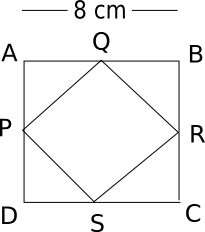
A square is drawn by joining the midpoints of the sides of a given square. A third square is drawn inside the second square in the same way and this process is continued indefinitely. If a side of the first square is 8 cm, the sum of the areas of all the squares such formed (in sq.cm.)is
 CAT WhatsApp Group